Most investors begin their financial journey by looking for the “best” investment - a fund, a stock, or a policy that promises high returns. But over time, experienced investors realize that wealth is not built by picking winners; it is built by constructing balance. That balance is what portfolio diversification brings.
Portfolio diversification is the process of spreading your money across different asset classes such as equity, debt, gold, or real estate so that no single investment determines your financial fate. It cushions your savings against unpredictable market swings, reduces overall risk, and ensures that your financial growth is steady rather than erratic. For anyone planning long-term goals like retirement, diversification is not a strategy of the cautious. It is the discipline of the wise.
How to Build a Balanced Portfolio
Diversification does not mean scattering money randomly across instruments. It is a thoughtful process of creating an allocation that suits your goals, income stability, and comfort with risk. A strong diversification plan should address both what you invest in and how you maintain it.
-
Define Your Investment Goals
The first step to creating a diversified investment portfolio is to clearly define your investment goals. These goals may be retirement planning, saving for your child's education, a house down payment fund, etc. Your goals will impact how you allocate your investments. For example, money you need in the short term should be invested more conservatively.
-
Identify your core asset classes
A well-balanced portfolio doesn't need to be complicated. For most Indian investors, these core building blocks work beautifully:
-
Equity: Fuels long-term growth and helps you beat inflation.
Examples: Equity mutual funds, diversified index funds, or direct stocks.
-
Debt: Brings stability and steady income to your portfolio.
Examples: Debt mutual funds, fixed deposits, or high-rated corporate and government bonds.
-
Gold or Alternatives: Acts as a safety net during uncertain times and protects against inflation.
Examples: Sovereign Gold Bonds (SGBs), Gold ETFs, or REITs for property exposure.
- Cash: Keeps your plan flexible by covering short-term needs or emergencies.
- Real Estate: Offers potential rental income and long-term appreciation, though it's less liquid compared to other assets.
Once this foundation is in place, adjust it based on your age, goals, and changing financial priorities.
-
Diversify Within Each Asset Class
True diversification goes deeper than just mixing asset types—it also means spreading risk within them. In equities, don't stick to one market segment. Combine large-cap funds for consistency with mid-cap or flexi-cap funds for faster growth.
For debt, balance short-term and long-duration funds, and mix government securities with solid corporate bonds. Even with gold, you can blend SGBs and ETFs to get both liquidity and steady value.
When you spread your investments smartly within each category, one weak link won't drag your portfolio down - the rest keeps working for you.
-
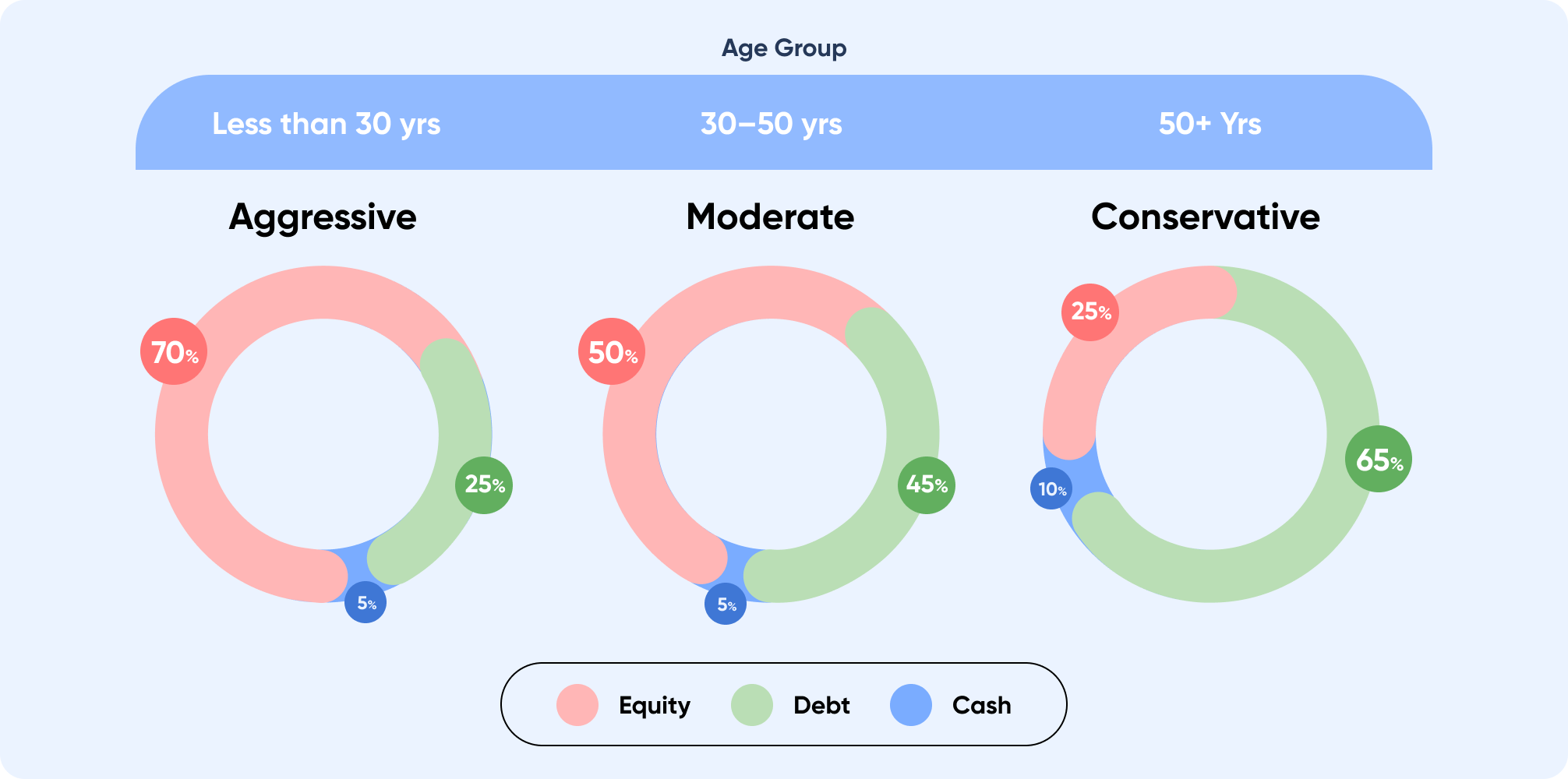
Use an age-based allocation as a starting point
A classic principle that still holds practical value is the “100 minus age” formula. If you are 35 years old, keeping around 65 percent of your portfolio in equities and the remaining 35 percent in more stable assets such as debt and gold provides a healthy balance between growth and protection.
This ratio need not be rigid. What matters is that your portfolio gradually shifts toward safety as you approach retirement or large financial milestones. Think of it as a gradual rebalancing of priorities - from wealth creation to wealth preservation.
-
Review and rebalance periodically
Over time, market performance can distort your original allocation. For instance, if equities outperform debt for a few years, they may become a larger share of your portfolio than intended. This can increase your risk exposure without you realizing it.
Rebalancing once or twice a year helps restore your portfolio to its intended proportions. You can do this by redirecting new investments toward underweighted assets or by partially booking profits from overgrown categories. This disciplined maintenance ensures that your portfolio continues to reflect your actual financial goals rather than short-term market movements.
Final Thoughts
Nowhere is diversification more crucial than in retirement planning. Retirement spans decades, and during that time, inflation, interest rate cycles, and market volatility can dramatically influence your savings. A diversified retirement portfolio helps balance three core objectives: growth before retirement, capital preservation near retirement, and income generation after retirement.
Equities help your savings grow fast enough to beat inflation. Debt ensures your corpus remains stable even during downturns. Gold or hybrid assets add resilience during unpredictable global or domestic events.
Once you retire, diversification continues to serve you through systematic withdrawal plans (SWPs), annuities, or a combination of the two. By maintaining a blend of equity and fixed-income instruments, you can keep drawing a steady income while letting part of your corpus continue to grow. Studies by global investment research firms like Morningstar have shown that balanced portfolios with 60 percent equity and 40 percent debt have historically delivered 8 to 10 percent annualized returns over long periods with much lower volatility than equity-heavy portfolios.
That steady reliability, not short bursts of profit, is what defines successful retirement planning.





 14 May 2026