





























Retirement Simplified
Calculators
Knowledge Centre
Who we are
Understand what an annuity is, how it works, and whether you should buy one after retirement. Learn about annuity types, examples, tax treatment in India, and how to choose the right plan for your needs.
Start Planning NowRetirement is often called the golden period - a time when you'd have real freedom to travel, spend time with family, or pursue hobbies. But for most of us, it also brings an unsettling question: how do I make sure my savings last?
An annuity plan is one way to answer that question, especially when you are already at retirement age. Think of it as buying a personal pension. You take a portion of your retirement corpus, invest in an insurance company, and in return, they pay you a regular income every month, quarter, or year - either for a fixed term or for life.
The key benefit? Predictability. You know exactly how much money you'll receive, which makes planning for essentials like groceries, rent, EMIs, or medical bills much simpler. It's like turning a lump sum into a salary for life, offering peace of mind that even if markets drop, a part of your income is secure.
But not all annuities are the same. Some start paying immediately, others wait. Some protect your spouse, while others return your principal to your heirs. Some increase payouts to match inflation, others stay fixed. Choosing the right annuity means understanding your goals, cash flow needs, and risk appetite.
In this guide, we'll break down all annuity types, provide real-life examples, explain taxation in India, and give a practical checklist to help you pick the plan that works best for your retirement.
You get monthly income of
For life from age 60
How total payout is calculated?
(Life expectancy – Pension start year) × Yearly Pension
Talk to an expert
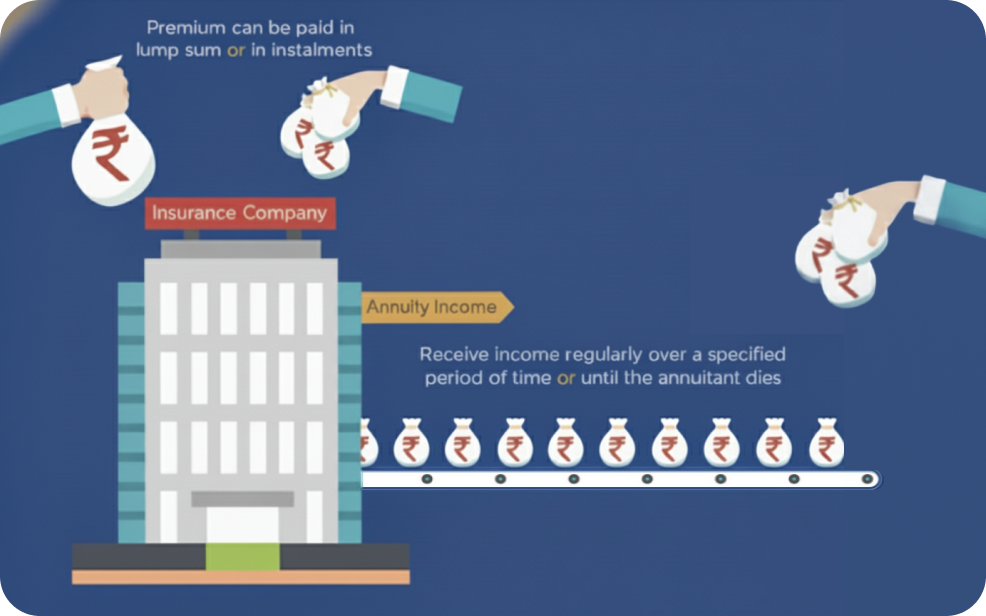
An annuity is basically a way to convert a chunk of your savings into a guaranteed stream of income, almost like creating your own pension. You pay an insurance company a lump sum, and in return, they promise to send you regular payouts for a set time period or for the rest of your life.
Investing your money
The insurer crunches the numbers
Your payout schedule begins
The income continues as promised
In an immediate annuity, you invest a lump sum (for example, ₹10 lakh at age 60) to start generating steady income right away. Other types of annuities, like deferred or phased-contribution plans, allow you to invest over time, with payouts beginning later.
They look at your age (how long they may need to pay you), your gender (life expectancy differences), the type of annuity you pick (life-long, fixed-term, or with survivor benefits), and sometimes even your health. All of this affects the monthly or annual payout amount.
Depending on the type of plan, payments may start immediately (immediate annuity) or after a planned wait period (deferred annuity). You choose if you want the money monthly, quarterly, or annually—whatever fits your lifestyle.
This could be for the rest of your life, for a fixed term (say 10 or 20 years), or until both you and your spouse pass away if you choose a joint-life option. Some plans also return your original investment to your nominee after death.
Once you buy an annuity, the lump sum typically can’t be withdrawn, but in exchange, you eliminate the risk of outliving your savings.
Here’s a quick guide to the most common types of annuities. They can be categorised into two parts — when you start receiving the income, and how you choose to receive it once the payouts begin.
Based on When You Invest and Start Receiving Income
Based on How the Annuity Works
Annuities turn your savings into a steady lifetime income, giving peace of mind in retirement. But like any financial product, they come with both comforts and compromises.
Guaranteed income for life
Once you start your annuity, you know a steady stream of money will keep coming as long as you live, so you don't have to stress about outliving your savings or worrying about market ups and downs in your later years.
Simple to manage
There's no need for monthly tracking, rebalancing, or second-guessing investment decisions; once it's set up, your annuity quietly does its job of providing income without your active involvement.
No market risk
Your payouts stay the same regardless of what happens in the stock or bond markets, making annuities especially comforting during volatile times when investment values fluctuate dramatically.
Spousal protection
Many annuity plans let you continue payments to your spouse after your passing, so even if you're no longer around, your partner won't lose that regular income stream they depend on.
Low liquidity
Once your money is used to purchase an annuity, it's generally locked in, meaning you can't easily access it for emergencies or large expenses later on.
Inflation risk
If your annuity pays a fixed amount, it might not keep pace with rising costs of living over the years, slowly reducing your purchasing power.
Lower potential returns
You're trading market growth potential for certainty, which means your money might not grow as much compared to staying invested in equities or mutual funds.
Taxable income
Many annuity plans let you continue payments to your spouse after your passing, so even if you're no longer around, your partner won't lose that regular income stream they depend on.
Contrary to a common misconception, annuity payouts are not tax-free. The income you receive from an annuity is treated as “Income from Other Sources” under the Income Tax Act, and is taxed according to your applicable income tax slab in the year of receipt.
Contributions and Tax Deduction
Taxation of Payouts
NPS-Backed Annuities
TDS Rules
Joint Life or Return of Purchase Price (ROP) Options
Choosing the right annuity is all about matching your retirement income to your real-life needs. Think of it as designing your own “retirement paycheck” plan - steady, predictable, and tailored to your lifestyle.
Choose between an immediate annuity, where payouts start right after you invest, or a deferred annuity, where payouts begin after a planned waiting period. Your choice affects how soon you get income and how much it will be
List must-pay monthly expenses - rent, groceries, medicines, EMIs, healthcare. These should be covered even if markets fluctuate
Pension, interest from FDs, rental income, or systematic withdrawals from investments give you a clear view of base income
Subtract regular income from essential expenses. The shortfall - say ₹25,000/month - guides how much you should invest in an annuity
Check at least three options (LIC, HDFC Life, ICICI Pru, SBI Life). Even 0.5% difference in rates can add up significantly
Consider options with increasing payouts (3%-5% per year) or keep part of your corpus in equity/balanced funds
Model post-retirement cash flows and test “what-if” scenarios so you know how much annuity you need and how much can remain invested elsewhere
Whether an annuity is right for you depends on what you value more - steady, guaranteed income or the freedom and growth potential of staying invested
Yes, if you value stability - Ideal for covering essential bills with guaranteed income for life
Partially, if you already have steady payouts - Use it as an extra cushion alongside pension or NPS
Not if you want flexibility or higher growth - Funds are locked in and growth is limited
Often best as a mix - Annuity for essentials, SWPs or mutual funds for growth and extras
Yes, fully taxable under income from other sources.
Yes, joint-life annuities continue payments after your death.
Mostly no; very limited surrender options exist.
Annuity gives certainty; SWP gives flexibility. Many retirees use both.
Typically ₹1 lakh, depending on the insurer.
An annuity can be a valuable tool to ensure financial security in retirement, especially for covering essential expenses. The key is to align your choice with your lifestyle, income needs, and long-term goals, combining guaranteed income with other investment avenues for flexibility and growth. Planning thoughtfully today can provide peace of mind for decades to come.
Feel free to adjust as you wish
Current household spend would be used to estimate the monthly expense post retirement..
Did you know that IIM Ahmedabad fees has increased from 15.5 L in 2015 to 27.5 L in 2025 - 5.4% annualised change!
We have assumed 6% increase in fees every year
The big Fat Indian wedding is constantly evolving with newer themes and a shift towards more experiential weddings
We have assumed 10% increase in wedding expense every year
International getaways are getting common but they don't come cheap!
We have assumed 6% inflation rate on travel
Real estate has been a key interest area for many investors which has led to sharp rise in prices in the recent times
We have assumed 8% annual increase in real estate prices
Cost of medical treatment and healthcare services is rising at a rapid pace with advancement in medical technology
We have assumed 12% annual increase for any medical emergencies
Did you know a Honda city costed 8 Lakhs in 2002 is now priced at 18 L (~4% annualised change)!
We have assumed a 5% annual inflation on these spends, you may want to buy a new car or plan a holiday etc.
Inflation is how prices of goods and services rise over time, meaning your money buys less than before. Simply put, things get more expensive each year
/month invested for next years @12% CAGR would yield
Your current savings saved for next years @ % would yield
Your total corpus would be + =