Open an NPS Vatsalya Account with PensionBazaar
Before working through the rules below, it helps to know that opening an NPS
Vatsalya account
does not require a separate CRA login or paperwork chase.
PensionBazaar lists NPS Vatsalya as its own dedicated product on the homepage,
alongside the
regular National Pension System, with a guided flow built specifically around a guardian opening
an account
for their child.
-
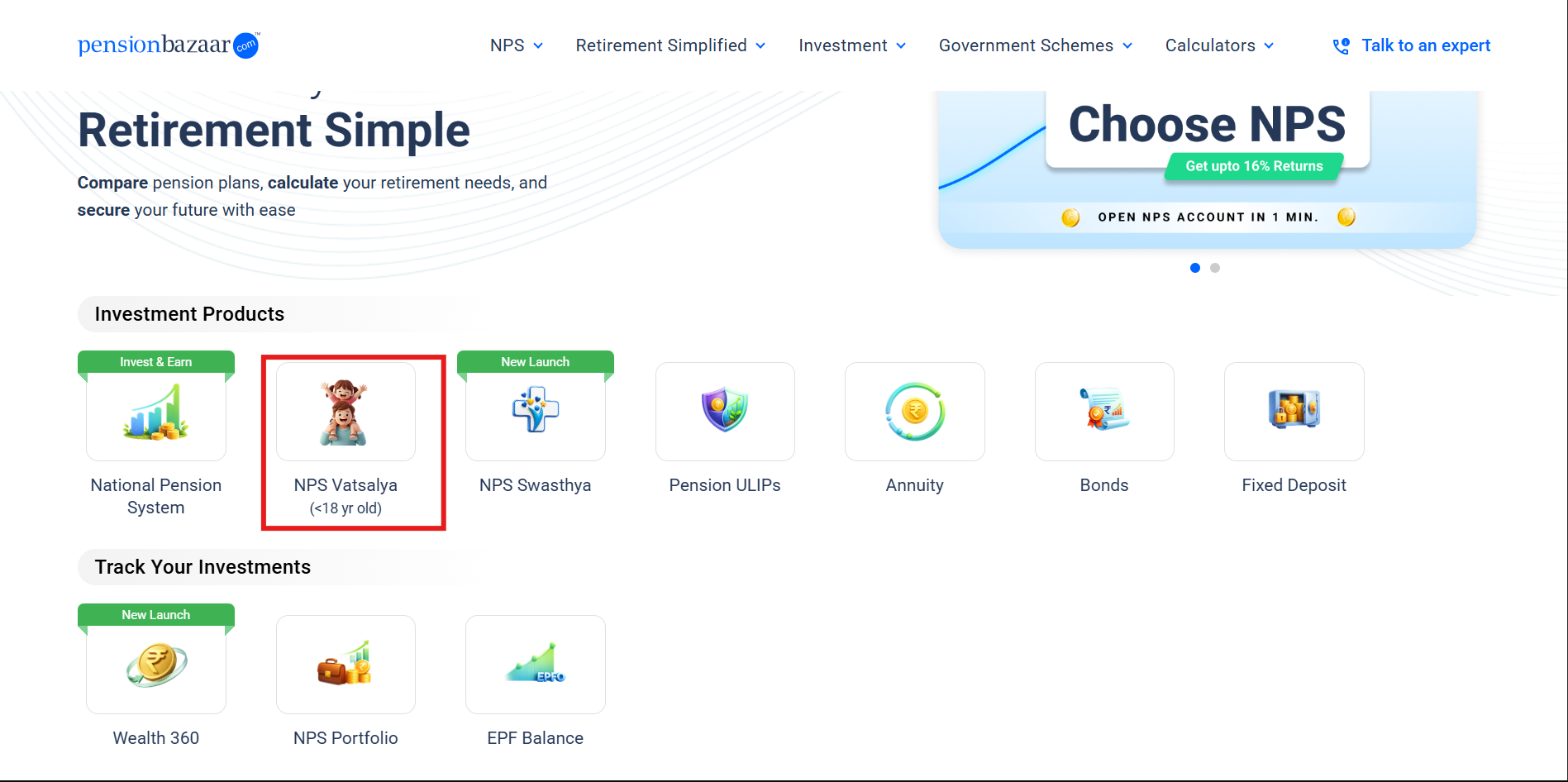
From the PensionBazaar homepage, select NPS Vatsalya
under
Investment Products.
-
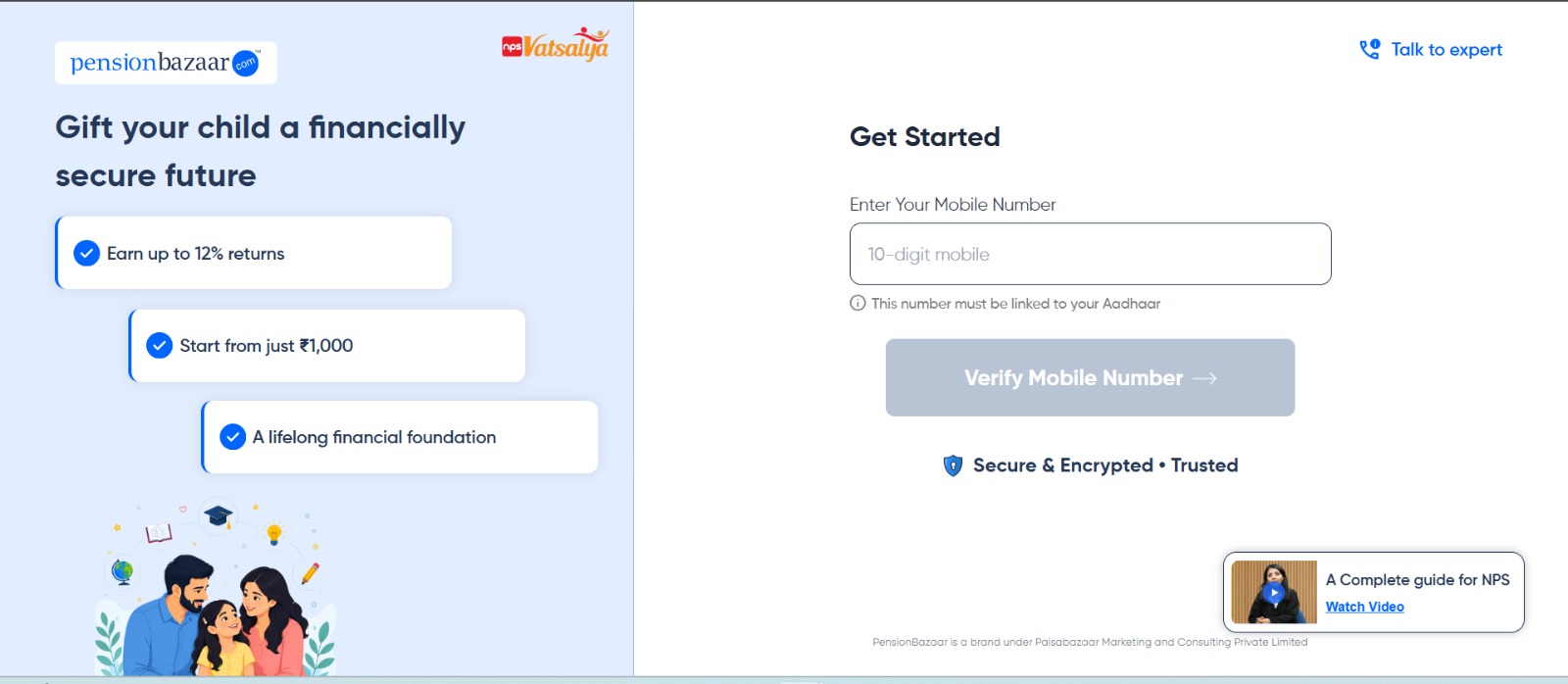
Enter a mobile number linked to your Aadhaar and verify it with the OTP
sent to that
number.
-
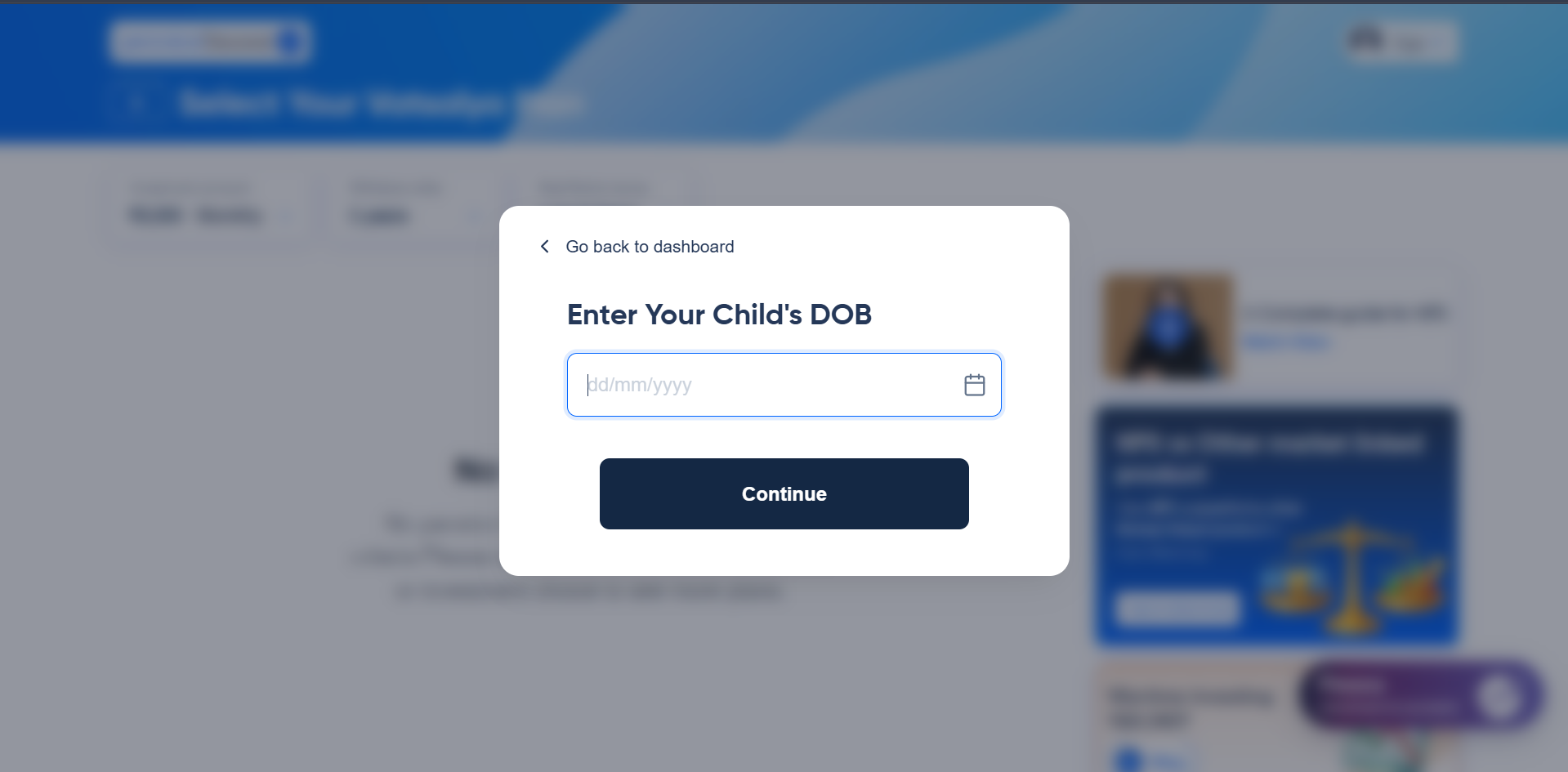
Enter your child's date of birth.
-
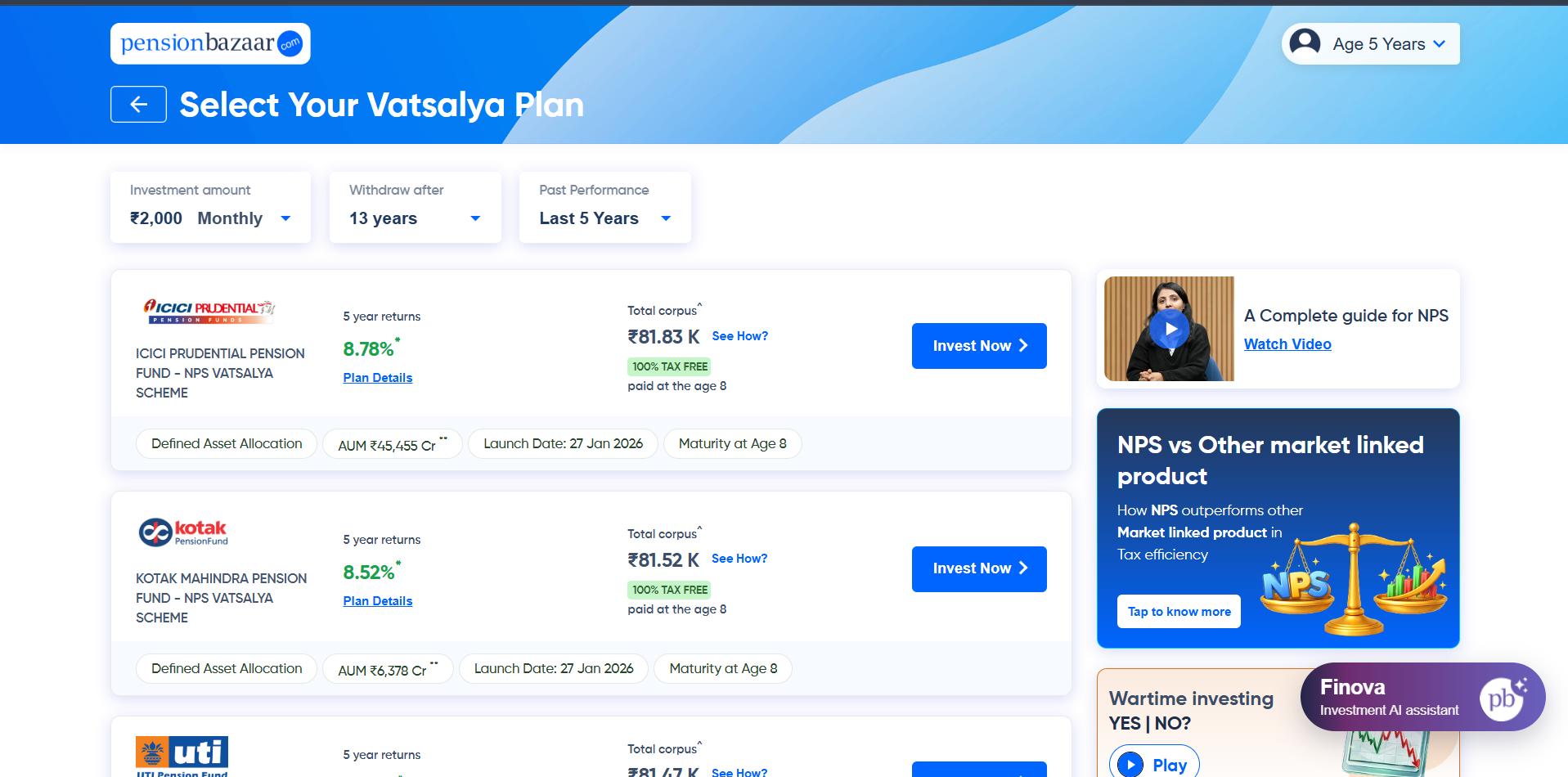
Explore the top Vatsalya plans shown for that age, compare returns and
total corpus
across Pension
Funds, and select Invest Now on the plan you want.
-
Provide the guardian's details, name as per PAN, PAN number, email and
date of birth,
and authorise
the KYC record download, then select Save and Continue.
-
CKYC verification begins at this point. Enter the OTP received from
CERSAI to
complete it.
-
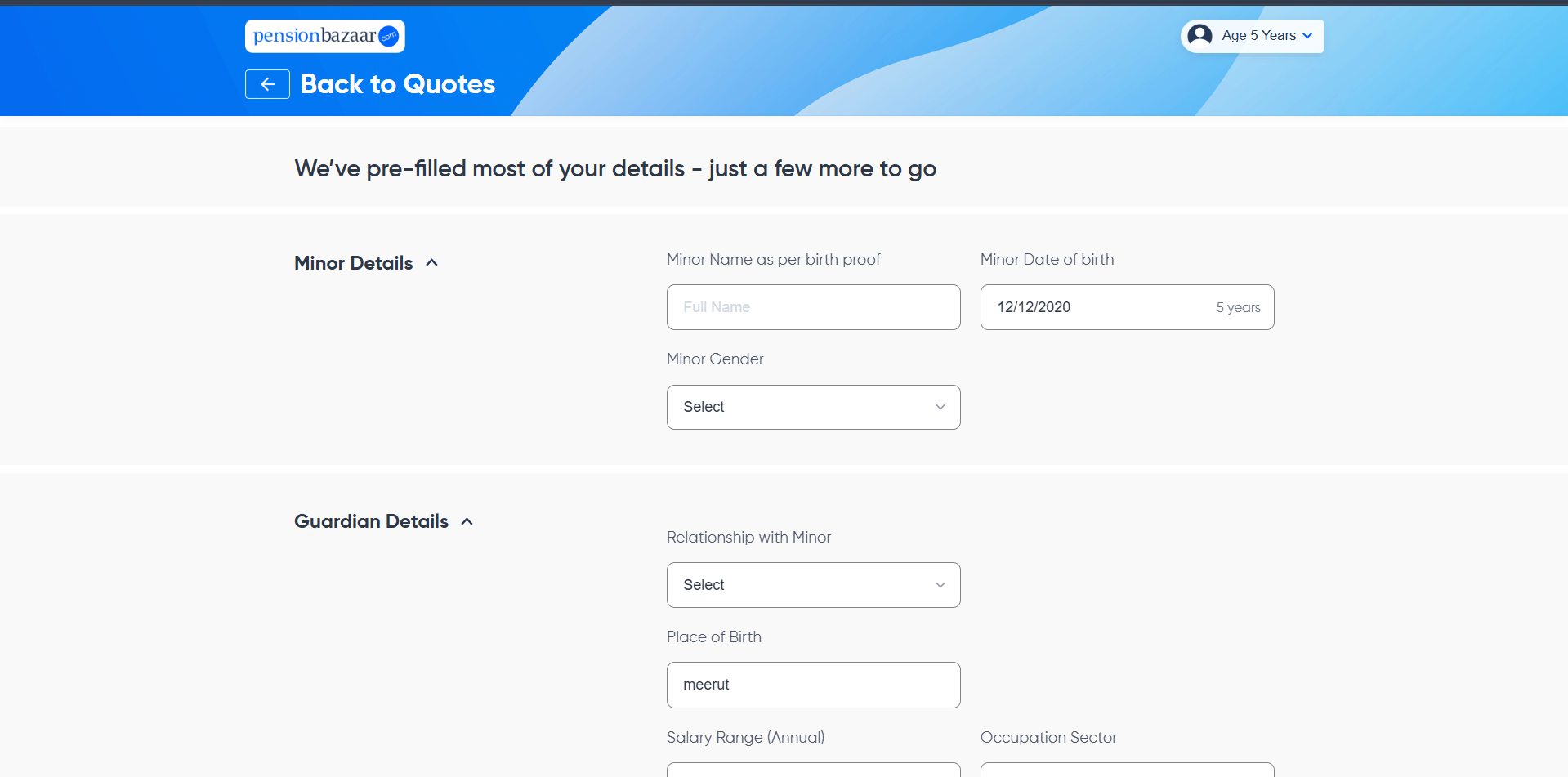
With the guardian's KYC verified, most fields are pre-filled. Complete
the minor's
details, name as
per birth proof, date of birth and gender, along with the guardian's relationship to the
minor and
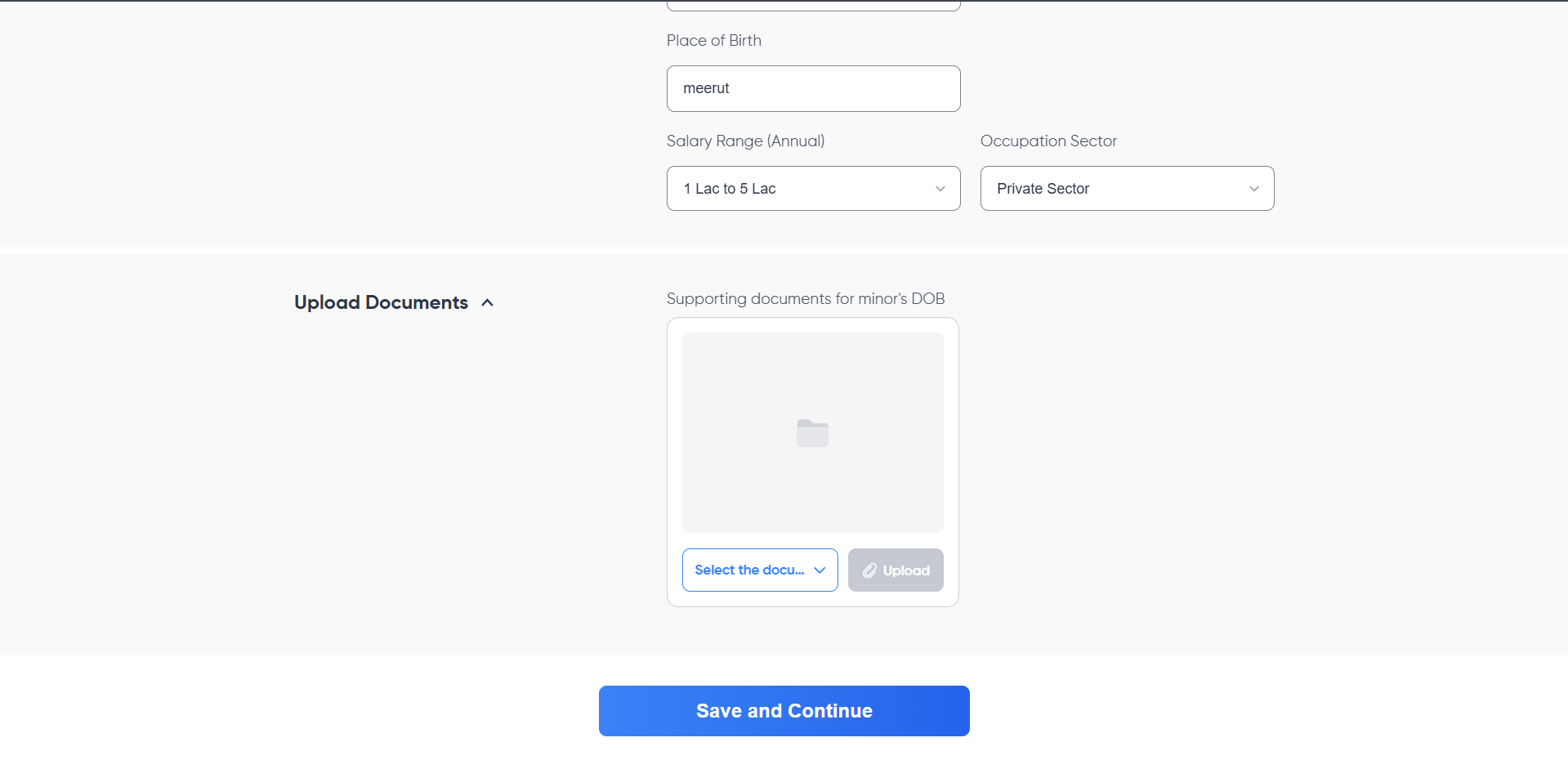
place of birth, upload the supporting documents requested, and select Save and
Continue.
-
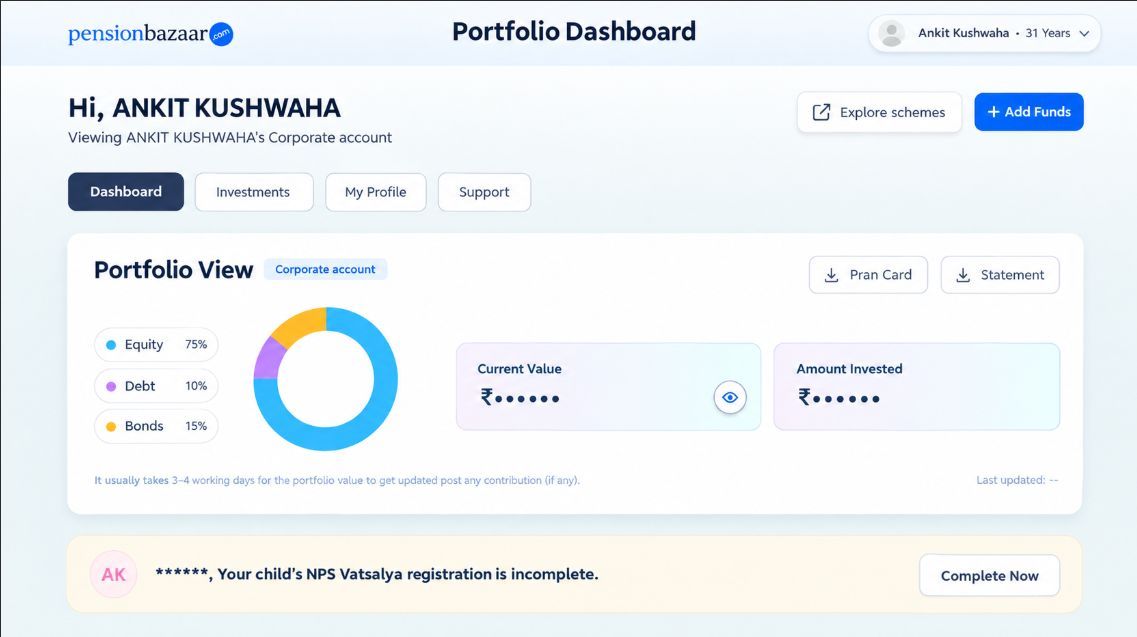
Once this is submitted, the application moves into processing, and the
account can be
tracked going
forward through the NPS Portfolio option on the PensionBazaar app,
alongside the
guardian's own retirement holdings.
A PensionBazaar
retirement
planning expert can walk through the Pension Fund and investment choice before you
commit, since
this decision is harder to revisit later than the amount contributed.
NPS Vatsalya at a Glance
| Parameter |
Current Rule |
| Regulator |
PFRDA, under the PFRDA Act, 2013 |
| Eligibility |
Indian minor below 18, including eligible NRI and OCI minors |
| Account holder |
The minor is the sole subscriber and beneficiary; a parent or legal guardian
operates the
account until 18 |
| Minimum contribution |
₹250 at account opening and ₹250 in every financial year; no maximum
contribution limit |
| Returns |
Market-linked, based on NAV performance; not a fixed or guaranteed interest rate
|
| Partial withdrawal |
Up to 25% of the subscriber's own contributions, excluding returns, twice before
18, for
specified purposes, after a three-year holding period |
| At age 18 |
Fresh KYC required; subscriber can continue under NPS Vatsalya until 21, shift
to the
applicable NPS structure, or exit under the applicable rules |
| At age 21 |
If no choice is made, holdings shift automatically to a higher-equity Multiple
Scheme
Framework scheme of the same Pension Fund |
| Exit after 18 |
Full lump sum withdrawal if the corpus is below ₹8 lakh; up to 80% lump sum with
the
remainder in annuity if the corpus is ₹8 lakh or more |
What is NPS Vatsalya and How Does it Work?
NPS Vatsalya is not a separate savings scheme running alongside NPS. It is a
minor-specific
version of the National Pension System (NPS)
that follows
the same rules, recordkeeping system and investment process as a regular NPS account.
The account has four stages. A parent or legal guardian opens it and completes
the minor's
KYC, after which a Permanent Retirement Account
Number, or PRAN, is issued in the child's name.
Contributions can be made by the guardian or other individuals to the account. A chosen Pension
Fund invests
that money across equity, government securities and debt, and the account's value moves with the
underlying
assets, so it rises and falls with the market rather than earning a fixed rate. Once the child
turns 18,
control of the account transfers from the guardian to the subscriber, who can then decide how to
proceed.
Who Owns and Operates the Account
The minor is the account's legal subscriber and its sole beneficiary throughout.
The guardian
who opens the account does not own the corpus; they operate it on the child's behalf until the
child turns
18 and completes fresh KYC in their own name.
How Contributions Become a Market-Linked Corpus
Each contribution buys units in the chosen investment scheme at the prevailing
Net Asset
Value (NAV). These units are valued depending on the performance of underlying investments like
equities,
government securities and debt. Thus, NPS Vatsalya does not provide a fixed interest rate or the
future
value of the corpus.
Who Can Open an NPS Vatsalya Account
Indian citizens under the age of 18 are eligible, as well as eligible NRI and OCI
minors. In
case the guardian is an NRI or an OCI, a NRE or NRO bank account is compulsory. The account can
be opened
and operated by a parent or legal guardian but relatives and other people can make contributions
to an
already opened account. The account can be opened and operated by a parent or a court-appointed
legal
guardian. A grandparent can be the guardian only if legally appointed as one. Otherwise, they
can still
contribute to an existing account. Only one NPS Vatsalya account can be opened per minor.
Eligibility for Resident, NRI and OCI Minors
A resident minor's account is opened and operated using the guardian's KYC along
with the
minor's date-of-birth proof. An NPS Vatsalya account can also be opened for an Indian citizen
below 18 when
the guardian is an NRI or OCI, subject to the applicable NRE or NRO account requirements.
Documents Required
Opening an account requires only a few basic documents.
- Proof of the minor's date of birth
- The guardian's KYC documents, typically Aadhaar and PAN
- PAN, or Form 60 where PAN is not yet available for the minor
- For an NRI or OCI guardian, the applicable NRE or NRO bank account details
Contribution Rules, Minimum, Maximum and Frequency
A minimum contribution of ₹250 is required to open the account, followed by a
minimum annual
contribution of ₹250 in each financial year. Subsequent individual contributions can be as low
as ₹10, and
there is no maximum contribution limit or restriction on the number of contributions in a
financial year.
Under the current framework, missing the ₹250 minimum in a given financial year does not
deactivate the
account before the child turns 18. Regular contributions can help build the corpus over time.
Investment Options, Returns and Charges
Several intermediaries manage different parts of an NPS Vatsalya account.
Understanding their
roles helps explain how the account is managed.
Choosing a CRA, Pension Fund and Investment Approach
The account records are kept by a Central Recordkeeping Agency, or CRA,
registration and the
collection of contributions is done by a Point of Presence, or PoP, and the money is actually
invested by a
Pension Fund. The Pension Fund and investment
method are chosen by the guardian, within the
restrictions of
the fund. They have the option of Active Choice to allocate it or Auto Choice to allocate it
using a
predefined allocation pattern. The variants of schemes available may vary between Pension Funds
and thus
what one provider has may not be exactly the same as what another has.
Does NPS Vatsalya Have a Fixed Interest Rate
No. There is no declared NPS Vatsalya
interest
rate. Contributions are invested in market-linked schemes that include equity,
government
securities, corporate debt and short-term money market instruments. Pension Funds may design
their own asset
allocation for NPS Vatsalya, including schemes with up to 100% equity exposure, or follow an
indicative
pattern with up to 75% equity, 20% government securities, 30% debt instruments and 10%
short-term
money-market instruments. The account's value moves with these holdings rather than accruing at
a fixed
rate, and past NPS performance in any asset
class does not predict future returns.
Charges and Switching
Charges follow the standard NPS cost structure set by PFRDA, covering CRA, PoP
and fund
management fees, and the exact schedule can vary by Pension Fund and CRA. A guardian can change
the Pension
Fund once in a financial year. Asset allocation or investment choice can be changed up to four
times in a
year, subject to the applicable PFRDA rules. Check the latest fee schedule and switching rules
with the
chosen CRA before making a change, as these may be revised through circulars.
NPS Vatsalya Withdrawal Rules Before Age 18
The withdrawal facility may
be assumed to be more flexible than it is, making it
important to
understand the applicable conditions. A partial withdrawal is allowed only after the account has
completed
three years from opening, only for a specified purpose, and only up to twice before the
subscriber turns 18.
Each withdrawal is capped at 25% of the subscriber's own contributions, excluding any investment
returns
earned on the contributions.
When is a Partial Withdrawal Allowed
Withdrawals are permitted for the minor's higher education, for treatment of
specified
illnesses, or where the minor has a disability of over 75%. These are the purposes currently
recognised
under PFRDA's framework, and a withdrawal request submitted outside these conditions may not be
approved.
How the 25% Limit is Calculated
The 25% cap applies to what the subscriber has actually contributed, not to the
account's
total corpus. For example, if a guardian has contributed ₹2,00,000 over several years and the
account has
grown to ₹2,40,000 including returns, the maximum available for one withdrawal is ₹50,000. The
figure is 25%
of the ₹2,00,000 contributed, not 25% of the ₹2,40,000 corpus. This figure is illustrative and
depends on
the account's actual contribution history.
What Happens at 18 and by Age 21
At 18, control of the account transfers to the subscriber, who gains access to
new options.
If no action is taken immediately, the account's treatment at 21 also becomes important.
Fresh KYC and Transfer of Control
Once the subscriber turns 18, control of the account shifts from the guardian to
the
subscriber. Fresh KYC and the required nominee details must be completed before further
withdrawals can be
made.
Continue Shift or Exit
Three options are available once fresh KYC is complete. The subscriber can remain
under NPS
Vatsalya until age 21, taking up to two additional partial withdrawals during this period under
the same 25%
and three-year conditions. They can shift the entire corpus into the standard NPS All Citizens
Model or
another applicable scheme. Or they can exit altogether, subject to the exit rules.
If No Choice is Made by Age 21
If the subscriber does not choose an option by age 21, the holdings are
automatically shifted
to a higher-equity scheme under the Multiple Scheme
Framework
managed by the same Pension Fund. Account transactions remain subject to up-to-date KYC.
Exit is based on the size of the corpus. Where the accumulated corpus is below ₹8
lakh, the
subscriber can withdraw the entire amount as a lump sum. Where the corpus is ₹8 lakh or more, up
to 80% can
be taken as a lump sum, with the remaining amount required to go into an annuity plan.
Tax Benefits and Tax Treatment
The NPS
Vatsalya tax benefits are often misunderstood because the deduction available on
contributions is
subject to specific limits and conditions.
Contribution Deduction, Old Regime Versus New Regime
Under the old tax regime, an eligible parent or guardian can claim a deduction of
up to
₹50,000 for NPS Vatsalya contributions under Section 124(4) of the Income-tax Act, 2025,
corresponding to
Section 80CCD(1B) of
the Income-tax Act, 1961. This deduction is capped at ₹50,000, and that cap
is shared
across the guardian's own NPS contributions and their contributions to any NPS Vatsalya accounts
they
operate, rather than being a separate ₹50,000 for each. No contribution deduction is available
under the new
tax regime. A tax professional should confirm the applicable section at the time of filing, as
the
renumbering is recent.
Tax on Partial Withdrawal Exit and Annuity
A permitted partial withdrawal of up to 25% of the minor subscriber's own
contributions,
excluding returns, is tax-exempt under the applicable provision. The exemption applies under
both the old
and new tax regimes. At exit, the portion PFRDA permits as a lump sum can be up to 80% of the
corpus once it
crosses ₹8 lakh. Current tax law exempts only up to 60% of the corpus as tax-free lump sum, so a
lump sum
taken above the threshold can attract tax. The amount used to purchase an annuity is exempt at
the time of
purchase, though the pension income the annuity later pays out is taxable as regular income.
Is NPS Vatsalya Right for Your Goal
NPS Vatsalya may suit some financial goals better than others, so it is important
to
understand its suitability before investing.
Consider It If
A guardian is planning for the long term investment, is comfortable with
market-linked,
non-guaranteed returns, and wants a regulated, low-cost way to begin retirement savings for a
child well
before that child starts earning.
Reconsider or Pair It If
Consider other options alongside NPS Vatsalya if you need funds for near-term
education
costs, easy access to your money, or returns that are not linked to market performance. Partial
withdrawal
is available, but only under specific conditions, so it should not be treated as a
general-purpose fund.
NPS Vatsalya Versus SSY, PPF and Mutual Funds
Comparing NPS Vatsalya with SSY, PPF or mutual
funds is useful when you consider the goal,
risk and liquidity offered by each option. Each serves different financial needs, so the right
choice
depends on the purpose of the investment.
| Product |
Primary Goal |
Return Type |
Liquidity Before Maturity |
| NPS Vatsalya |
Retirement corpus, started early |
Market-linked, not guaranteed |
Limited, conditional partial withdrawal only |
| Sukanya Samriddhi Yojana |
Girl child's education or marriage |
Fixed, government-notified rate |
Limited, permitted for specific purposes |
| Public Provident Fund |
General long-term savings |
Fixed, government-notified rate |
Limited, partial withdrawal after year 7 |
| Mutual Funds (equity or debt) |
Flexible, goal-dependent |
Market-linked, not guaranteed |
High, redeemable on demand in most schemes |
Other Ways to Open an NPS Vatsalya Account
The process of opening an NPS Vatsalya account is an easy one when the necessary
documents
are prepared. The guardian is able to file the documents and finish the registration using the
channels
available. After the application has been confirmed, it is possible to open an account and start
making
contributions.
Opening the Account Online
The NPS
registration process on the NPS Trust's eNPS platform lets a guardian complete the
entire
application without visiting a branch.
- Visit the eNPS portal and select the NPS Vatsalya registration option
- Enter the guardian's own PRAN if one already exists, or complete the guardian's KYC first if
not
- Fill in the minor's details and upload date-of-birth proof
- Complete the guardian's KYC verification, typically through Aadhaar-based e-KYC
- Choose the CRA, the Pension Fund and the investment approach for the account
- Make the initial ₹250 contribution online to generate the minor's PRAN
Opening the Account Offline
A registered Point of Presence, such as a participating bank or another eligible
institution,
handles the same application in person for guardians who prefer not to complete it online.
- Locate a registered Point of Presence, most commonly a bank branch
- Collect and fill in the NPS Vatsalya account-opening form
- Submit the minor's date-of-birth proof along with the guardian's KYC documents
- Submit the minor's PAN, or Form 60 where PAN is not yet available
- Choose the Pension Fund and investment scheme with help from the PoP if needed
- Pay the initial ₹250 contribution at the branch to complete registration and generate the
PRAN
Before You Start Checklist
- Minor's date-of-birth proof ready
- Guardian's Aadhaar and PAN ready
- Minor's PAN or Form 60
- Chosen CRA and Pension Fund decided in advance
- First contribution of at least ₹250 arranged
Death Guardian Change and Grievances
In case of the death of the subscriber, the nominee or the heir receives a
payment of the
accumulated corpus according to the records of the account. In case the person serving as the
guardian of
the account dies or becomes incapable of doing so, the person may be replaced by a new guardian
to operate
the account, but the corpus itself is not influenced by this. Any complaint regarding the
account may be
filed through the CRA or PFRDA grievance mechanism using the
Pension Sahayak portal.
Conclusion
NPS Vatsalya gives a family a regulated, market-linked way to start a child's
retirement
savings decades before that child will need them. The scheme's rules around contributions,
withdrawals and
the transition at 18 have changed since its 2024 launch. Accurate figures, such as ₹250 instead
of ₹1,000,
two withdrawals instead of three, and an ₹8 lakh exit limit, are more useful for planning than a
headline
return figure. Consult with a PensionBazaar
retirement planning
expert to see whether NPS Vatsalya fits alongside your other savings goals for your child.



 05 Oct 2026