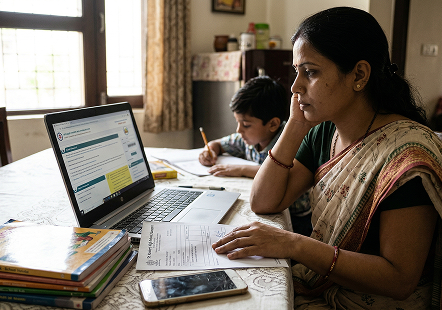
How to Check SSY Account Balance Online
Whether you can check your Sukanya Samriddhi Yojana balance online depends entirely on your
bank, since not every bank has enabled this for SSY accounts yet. Where it's available, you have four ways
to do it.
-
Net Banking
- Log in to your bank's internet banking portal using your registered user ID and password
- Go to the Accounts, Deposits or Small Savings section on the dashboard
- Select your Sukanya Samriddhi account from the list
- Check your current balance along with recent transaction details
-
Mobile Banking App
- Open your bank's official mobile app and log in with your existing credentials
- Navigate to the Accounts or Government Schemes section
- Select your SSY account
- Check the available balance and transaction history on screen
-
IPPB for Post Office Accounts
If you opened your account at a post office, the India Post Payments Bank app gives
you a similar digital route.
- Download the IPPB app and register using your Aadhaar-linked mobile number
- Add your Department of Posts customer ID or link your SSY account under DOP products
- Select the Sukanya Samriddhi option to view your balance
- Use the same app to transfer deposits into the account when you need to
-
SMS Banking
If you want to skip logging into an app altogether, SMS banking gives you a quick
Sukanya Samriddhi Yojana balance check as a text message, once you have registered for it. The steps
below cover how:
- Visit your branch once to register your mobile number for SMS banking
- Send the specified keyword, such as "BAL" or "balance," to your bank's SMS banking number
- Get your current balance and last transaction details by text within minutes
How to Check Sukanya Samriddhi Account Balance Offline
When you don't have online access, or you simply prefer a physical record, the offline route
works reliably at every bank and post office.
-
Updating Your Passbook
- Carry your Sukanya Samriddhi account passbook to the branch or post office where you opened the
account
- Ask the staff to update it with your latest deposits and interest credited
- Review the updated entries, which show each deposit date, the interest applied, and your running
balance
Update the passbook once a year, ideally right after the annual interest credit in
the new financial year, so the physical record matches what the bank shows on its systems.
-
Branch or Post Office Inquiry
If you have lost or don't have your passbook on hand, you can still get your balance
directly at the counter. Here's what to carry and ask for:
- Carry your account number and a valid ID to the branch or post office
- Ask the staff for a manual balance inquiry
- Request a duplicate passbook if you have lost the original, so future updates go smoothly
Even where digital banking isn't available yet, the passbook remains fully valid and
reflects every transaction accurately, so you lose nothing by relying on it.
Estimate Your Future SSY Balance
Once you know your current balance, the natural next question is what it will grow into by
the time the account matures. You don't need a separate tool for a rough estimate, the same 8.2% annual
compounding rate used to calculate your interest lets you project forward. Here's how to work it out:
- Take your current balance and add your planned annual deposit for each remaining year
- Apply 8.2% compounding annually, since that's how the account calculates interest
- Remember that deposits stop after year 15, but the balance keeps compounding until maturity at year 21
- Treat the estimate as approximate, since the government revises the interest rate every quarter and it
may not stay at 8.2% for the full remaining tenure
For example, if your account already holds ₹5 lakh after eight years of ₹62,500 deposits,
continuing at the same pace for the remaining seven years would take the invested amount to roughly ₹14.3
lakh by year 15. With no further deposits after that, compounding alone would carry it to approximately
₹22.9 lakh by maturity at year 21.
Conclusion
A Sukanya Samriddhi Yojana balance check comes down to whichever method your bank or post
office supports. Net banking and mobile apps work fastest where you have access, SMS gives you a lighter
backup, and the passbook works everywhere else. Check in at least once a year, right after the annual
interest credit, to keep your records accurate and catch any missed deposits early.




 22 Oct 2026