















































































Mutual Funds

Investment, Types, and Benefits

A mutual fund is a professionally managed investment. Over time, the industry has expanded notably, with Assets Under Management (AUM)

as on 30th April, 2016

₹14.22 lakh crore

as on 30th April, 2026

₹81.92 lakh crore

Let’s understand how the mutual funds work, their classification, costs involved and the factors to look for before investing.

money jar

Top Performing Mutual funds

₹205,278.08 Cr.
248.81
₹140,949.13 Cr.
81.09
₹104,016.21 Cr.
504.55

Written by

Vishwajeet Goel

What are Mutual Funds?

Mutual funds gather money from many investors and invest it into equities, bonds, money market instruments or ETF units. Investors are assigned units and any returns are distributed after subtracting fund expenses such as management and operating costs (expense ratio).

The unit value is determined through Net Asset Value (NAV). It is computed daily and applied for valuation on a regular basis. For example, when a fund holds assets worth ₹200 crore and 10 crore units, NAV equals ₹20 per unit. Mutual funds, being market-linked, do not guarantee returns. They deliver higher growth potential than traditional options while reducing risk via diversification. 

Types of Mutual Funds Based on Asset Class

₹205,278.08 Cr.
248.81
₹140,949.13 Cr.
81.09
₹101,821.82 Cr.
1,926.22

Types of Mutual Funds

Mutual funds can be classified into different types based on

Different money approch Elders in India

Classification by Organisation Structure

Open-Ended Funds

These funds allow investors to buy or redeem units on any business day at the current NAV. This ensures high liquidity and flexibility.

Open-Ended Funds

These funds allow investors to buy or redeem units on any business day at the current NAV. This ensures high liquidity and flexibility.

Open-Ended Funds

These funds allow investors to buy or redeem units on any business day at the current NAV. This ensures high liquidity and flexibility.

Fund Types Based on Portfolio Management

Active Funds

These funds are mainly managed by experts who actively buy, hold, and sell securities to outperform the market. Here, returns depend on mutual fund manager decisions, so risk and performance may vary accordingly.

Passive Funds

These funds track a chosen market index to match its performance closely rather than making active choices. Examples include index funds and ETFs, which offer lower costs due to minimal management involvement.

Fund Types Based on Investment Objective

Growth Funds

Focusing on long-term growth through equities, this suits medium to long-term goals despite short-term fluctuations. Funds with a beta above 1 are more volatile, while those below 1 are relatively stable.

Income Funds

Steady income is generated by investing in fixed-income instruments such as bonds, debentures, and government securities. Returns depend on interest earnings and market conditions, and regular income is not guaranteed.

Liquid Funds

Allocate investments to very short-term instruments with maturities of up to 91 days. They are ideal for parking surplus money for short periods while maintaining high liquidity and relatively stable returns.

Tax-Saving Funds (ELSS)

Reduce taxable income under Section 80C while investing mainly in equities. Comes with a lock-in period and supports long-term wealth creation benefits for long-term planning growth.

Classification by Asset Allocation

Equity Funds

Focusing on stocks and equity instruments for long-term growth, these suit investors with a higher risk appetite. Short-term returns fluctuate with the market, but long-term returns historically average 10%–12%.

Hybrid Funds

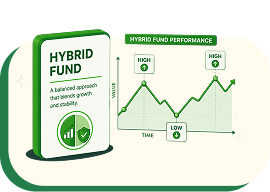
Mix investments in equity and debt to achieve growth and stability. In aggressive hybrid funds, roughly 65%–80% is directed to equities, with remaining balance allocated to debt depending on strategy allocation.

Multi-Asset Funds

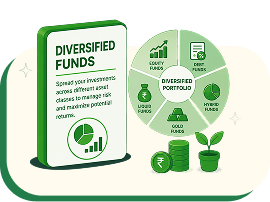
Diversifying investments across various asset classes, including equity, debt, and gold commodities, reduces overall risk. This approach targets steadier returns during periods of changing market volatility. 

Tax-Saving Funds (ELSS)

Reduce taxable income under Section 80C while investing mainly in equities. Comes with a lock-in period and supports long-term wealth creation benefits for long-term planning growth.

Other Categories

Exchange-Traded Funds (ETFs)

Traded on stock exchanges like regular shares, these funds track an index or asset. These are passively managed, include lower costs, and ensure liquidity during trading hours.

Fund of Funds (FoF)

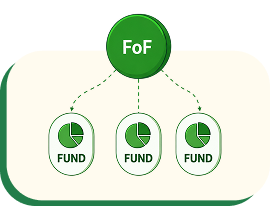
Invests in mutual funds instead of direct investment in stocks or bonds. They deliver diversification but can result in higher costs from multiple management layers' structure charges. 

Overseas Funds

Enables access to international markets through investment in global shares and securities. This supports portfolio diversification but may be affected by currency movements and broader global economic changes. 

Solution-Oriented Funds

Structured to achieve defined financial goals like retirement planning or children's education, keeping investors focused on long-term objectives aligned steadily.

Mutual Funds companies in India

aditya-birla-sun-life-mutual-fund taurus-mutual-fund 360-one-mutual-fund axis-mutual-fund bajaj-finserv-mutual-fund bandhan-mutual-fund bank-of-india-mutual-fund baroda-bnp-paribas-mutual-fund canara-robeco-mutual-fund capitalmind-mutual-fund dsp-mutual-fund edelweiss-mutual-fund sbi-mutual-fund hdfc-mutual-fund iti-mutual-fund

How to Invest in Mutual Funds

Mutual fund investing remains simple and follows several clear, well-planned steps for completion process:

Step 1 Complete KYC Registration

Finish one-time KYC with PAN and Aadhaar. Several platforms offer Video-KYC, making the process quick and a fully digital setup stage.

step 1

Step 2 Establish Investment Goals

Decide whether allocation focuses on short-term savings, long-term wealth creation, retirement, or educational needs now here.

step 2

Step 3 Select a Suitable Mutual Fund

Investment across equity, debt or hybrid funds depending on risk tolerance and investment horizon. Analyse performance and fund approach before investing.

step 3

Step 4 Decide Your Investment Approach

Pick how you want to invest

  • SIP:
    Invest regularly (starting from ₹500 or ₹250 for small SIPs)

  • Lump Sum:
    Invest a larger amount at once 

step 4

Step 5 Monitor and Adjust Your Portfolio

Check your investments regularly and adjust them to stay aligned with your goals and market conditions.

step 5

Benefits of Investing in Mutual Funds

Mutual funds provide several benefits, such as:

Low Starting Amount

Investing can begin with as little as ₹500 per month through SIP, and even cheaper with "Choti SIP" alternatives starting at ₹250, making it accessible to most persons.

Benefit of Compounding

Regular investing grows wealth through compounding. For example, ₹5,000 monthly at 12% can reach about ₹50 lakh in 20 years.

Professional Management

The investments are managed by skilled fund managers and research teams. They research the market trends and make informed decisions on investments on your behalf on a regular basis.

Tax Benefits

Diversifying investments across various asset classes, including equity, debt, and gold commodities, reduces overall risk. This approach targets steadier returns during periods of changing market volatility.

Key Factors to Consider Before Investing

Several important factors require attention before investing decisions are made, such as:

Define Your Investment Goal

Be clear about your financial objective and time horizon, as this helps in selecting the right type of mutual fund.

Understand Available Schemes

Compare mutual fund options for suitability based on risk level and expected return outcomes, carefully aligned.

Choose the Right Fund Type

Depending on risk appetite, equity, debt or hybrid funds may be selected, with low risk for beginners overall.

Evaluate and Compare Funds

Evaluate shortlisted funds using expense ratio, portfolio composition, and past performance before investing decisions.

Complete KYC Compliance

Submission of PAN and address proof documents is required for the investment approval stage verification process here.

Focus on Diversification

Invest across different fund types to reduce risk and build a balanced portfolio structure plan. A balanced portfolio can contain 3–5 funds across equity, debt, and other asset classes for proper risk control.

Costs or Charges Involved in Mutual Funds

Mutual funds deliver several benefits making them an appropriate option for new and experienced investors alike:

Cost Component Details
Expense Ratio (TER) It is the yearly fee that the fund house charges, which is normally between 0.5% to 2.25%, depending on the type of fund. Direct plans are less expensive in terms of ratio as they do not involve distributor commissions.
Exit Load Usually, 1% charged when redeemed within 1 year for equity funds and nearly 0.5% within 6 months for debt funds. Liquid funds have graded exit loads for withdrawals within 7 days, while overnight funds carry no exit load.
Securities Transaction Tax (STT) Charged at 0.001% on redemption of equity-oriented funds (including equity-heavy hybrid funds). Not applicable to debt funds.
Switching Charges Generally, 1% is charged when redeemed within 1 year for equity funds and close to 0.5% within 6 months for debt funds. Liquid funds can have graded exit loads for withdrawals within 7 days, while overnight funds carry no exit load.
Management Fee Part of the expense ratio, typically forming a major portion of the 0.5%–2.25% TER, is paid to fund managers for handling the portfolio.
GST (Goods and Services Tax) Charged at 18% on fund management and advisory services, already part of expense ratio, which reduces net returns overall.
Advisor / Distribution Fees Regular plans include commissions within TER, up to 1% gap compared with direct plans. Direct plans have no distributor commission, improving cost efficiency overall in general terms.
key takeaway

Key Takeaway

Mutual funds allow a flexible and simple path to build wealth using diversified professional investment management teams. With various fund categories, easy investment steps, and SIP options, they meet different financial goals effectively. Clear knowledge of costs, risks and fund selection enables investors to make informed decisions and long-term financial growth. 

FAQS

No, mutual funds are not insured like bank deposits and carry market risk. The value of your investment can go up or down based on the performance of the underlying assets. As a result, investors may experience gains or losses depending on market conditions and fund performance.

The expense ratio is deducted from the fund's assets on a daily basis, which reduces the Net Asset Value (NAV) of the scheme. A higher expense ratio can lower the net returns earned by investors over time, making it an important factor to consider when comparing mutual funds.

Diversification is one of the key benefits of mutual funds. These funds invest across multiple securities, sectors, and asset classes, helping spread risk. As a result, the poor performance of a single investment is less likely to have a significant impact on the overall portfolio, which can help provide more stable returns over time.

The suitability of mutual funds for short-term investing depends on the type of fund. Liquid funds and short-duration debt funds are generally considered appropriate for short-term financial goals due to their lower risk and relatively stable returns. Equity mutual funds, on the other hand, are better suited for long-term wealth creation, as their performance can be affected by short-term market fluctuations and volatility.

The performance of a mutual fund is influenced by several factors, including the investment decisions made by the fund manager, prevailing market conditions, asset allocation strategy, and the quality of the underlying securities held in the portfolio. A well-managed and diversified portfolio can help generate better risk-adjusted returns over time, although past performance does not guarantee future results.

Profile

Retirement is not the end of earning

- it's the beginning of living on your own terms

India is at a turning point. A growing middle class, longer lifespans, and rising aspirations mean that how we plan for our later years has never mattered more. Yet most of us are underprepared. PensionBazaar exists to close that gap - with clarity, simplicity, and the right plan for every stage of life. Your future self deserves nothing less.

Vishwajeet Goel Linkedin - Leadership Team, PensionBazaar

article

calender-icon 16 Jun 2026

NPS Tier II Account vs Mutual Funds: Which Is Better for Investment?

NPS is a retirement-oriented and government-backed saving scheme with a lon...

article

calender-icon 16 Jun 2026

NPS for NRI: Features, Benefits & Investment Process

For an NRI planning to retire in India, NPS can be the right choice. Can NR...

article

calender-icon 16 Jun 2026

The Fixed Deposit Playbook: How to Actually Build Wealth Without Market Risk

Millions of Indians are silently losing money while believing it is perfect...

article

calender-icon 16 Jun 2026

ULIP Pension Plan: Why Your Retirement Needs Market-Linked Growth

A ULIP pension plan combines life insurance with aggressive market-linked g...

article

calender-icon 11 Jun 2026

Joint Family System Breakdown in India: Reasons and Impact

The old joint family system has gradually declined due to rapid urbanisatio...

article

calender-icon 11 Jun 2026

Long-Term Care in India: Why It Matters for Retirement Planning (2026)

As life expectancy rises in India, retirement is no longer just about havin...