The National Pension System (NPS) is a low-cost, tax-efficient way to build your
retirement corpus. With professional fund management and flexible options, it helps you grow
your
savings steadily and secure your financial future with ease.
Start Planning Now
Everything You Need To Know About The National Pension System
Retirement planning is easier when you start early. NPS or the National Pension System is the government's
longest-running effort to build a habit of long-term savings across the country. It is a market-linked
retirement plan where contributions are invested in a mix of equity, corporate bonds, and government
securities managed by professional Pension Fund Managers to grow your savings steadily over time.
Regulated by the Pension Fund Regulatory and Development Authority (PFRDA), NPS is low-cost, tax-efficient,
and now more flexible than ever, helping individuals - whether salaried, self-employed, or freelancers -
9systematically accumulate a retirement corpus while balancing growth and risk.
This instrument enforces the discipline needed for compounding to work its magic. It comes at the lowest
possible charges, or what one might call an expense ratio. It falls under the EEE (Exempt-Exempt-Exempt)
category - giving you a rare edge by keeping your returns completely free of capital gains tax.
Let's take a look at its key features:
Power of Compounding
Even small, regular contributions grow exponentially over time
because
your returns start earning returns, turning modest savings into a substantial retirement
corpus
over decades
Lowest Costs
Fund management fees just 0.01 - 0.09% vs 1 - 2% for mutual funds
Tax-free at all stages (EEE)
Contributions, growth, and partial withdrawals are tax-efficient
Greater Flexibility(2025 reforms)
Option for exit after 15 year tenure, 100% equity under MSF,
multiple
PRANs under one PAN and the option to withdraw 80% lumpsum
Equity + Debt Mix
Balanced growth and safety over time
NPS 2.0: More Flexible, More Personalized
The National Pension System has undergone significant updates in 2025 to provide more
flexibility
and personalization options for subscribers. These changes make NPS more accessible and tailored to
individual
needs.
Subscribers can now enjoy greater flexibility in investment choices, with expanded options
for
asset allocation and more personalized portfolio management. The system now offers enhanced features for
tracking and managing your retirement savings.
The new updates also simplify the account opening process and provide better support for
subscribers throughout their NPS journey. With these improvements, NPS continues to be one of the most
comprehensive retirement planning solutions available.
Whether you're just starting your career or planning for retirement, the updated NPS 2025
offers
features that can help you build a secure financial future.
How to Open an NPS Account and Select the Right Options
You can start your NPS journey on nps.pensionbazaar.com in less than a minute, with a fully
digital and hassle-free account opening process. Opening an NPS account is simple and open to anyone
between 18 and 85 years, including salaried employees, self-employed professionals, freelancers, and
NRIs. All that's required is basic KYC documentation, such as a government-issued ID and address proof.
Your Permanent Retirement Account Number (PRAN) stays with you for life, allowing you to continue
contributing seamlessly even if you change jobs, move cities, or relocate abroad.
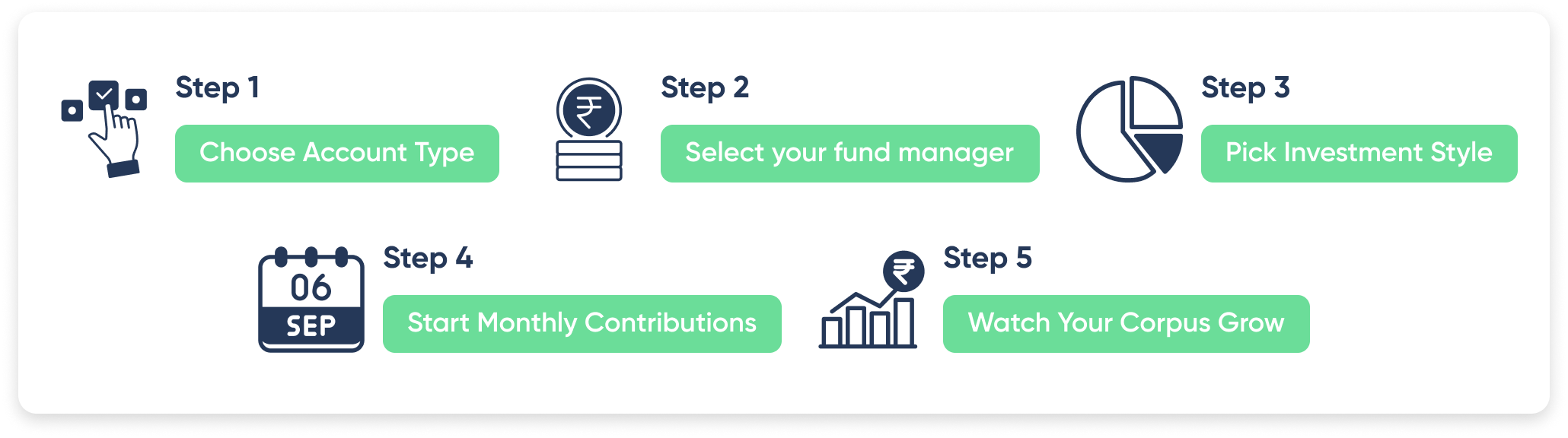
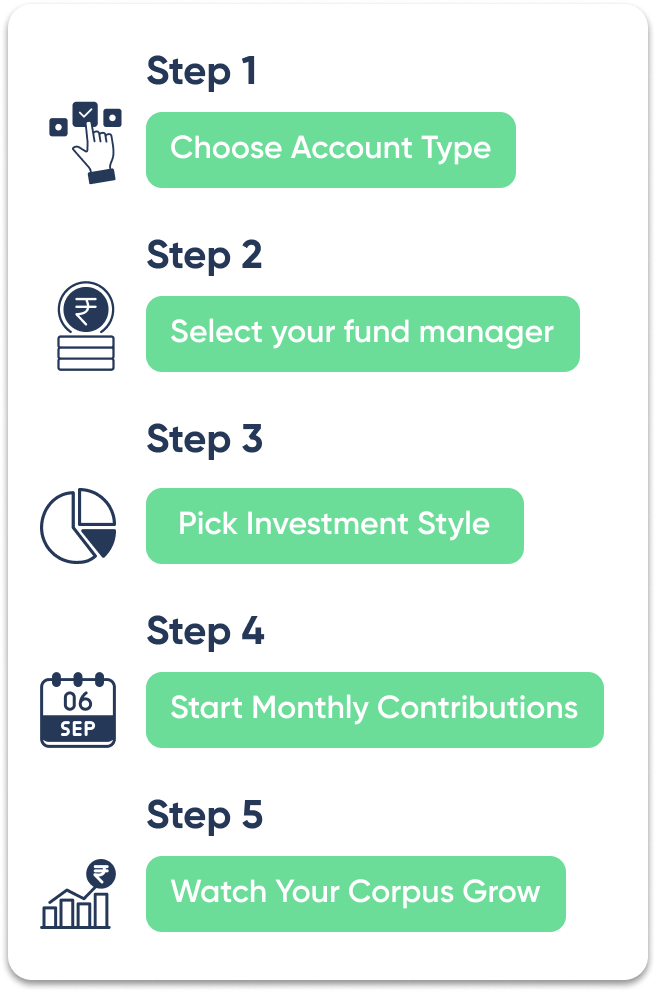
Step 1: Choose Your Account Type
Tier I - Retirement-focused (Mandatory): Offers tax
benefits
and enforces
long-term discipline. Partial withdrawals are allowed for specific life events such as
education,
marriage, illness, or buying/construction of a home.
Tier II - Flexible savings (Optional): Offers full
liquidity
with no tax
benefits; ideal for short- or medium-term savings.
Step 2: Choose Your Pension Fund Manager (PFM)
Pick from 10 trusted Pension Fund Managers such as HDFC Pension Fund,
ICICI
Prudential Pension Fund, SBI Pension Fund, Aditya Birla Sun Life Pension Fund, Kotak
Mahindra
Pension Fund, Axis Pension Fund, LIC Pension Fund, DSP Pension Fund, Tata Pension Fund,
or UTI
Pension Fund. With the new Multiple Scheme option, you can invest across several fund
managers
while
still tracking all your savings under a single Permanent Retirement Account Number
(PRAN).
Step 3: Choose Your Investment Style
Auto Choice (Lifecycle Fund): A hands-free, age-based
allocation that automatically adjusts your money mix between equity and debt as you grow
older -
taking higher risk when you're young and becoming safer as you near retirement. Types of
Auto
Choice
Funds
Life Cycle 25(Low) - Equity exposure starts at 25% and tapers to
around 5%
by age 55
Life Cycle 50(Moderate) -Equity exposure begins at 50% and reduces
to 10%
by 55
Life Cycle 75(High) -Equity starts at 75% and gradually drops to
15% by 55
Life Cycle Aggressive (formerly Balanced Life cycle Fund) - Equity
starts
at 50% and gradually
drops to 35% by 55
Active Choice: Gives full control over your equity,
corporate
bonds, government securities, and alternative asset allocation. Under 2025 reforms, you
can now
go
up to 100% equity under MSF, giving experienced investors higher growth potential if
they can
tolerate short-term volatility. Annual rebalancing is still available, and now you can
rebalance
across schemes under the same PRAN
Multiple Scheme Framework(New) : MSF lets you
invest in
multiple pension
schemes under a single PRAN, enabling better diversification across fund managers and
strategies.
With the 2025 reforms, MSF also allows up to 100% equity allocation under eligible
schemes,
maximising long-term growth potential for investors who can handle market volatility.
You can
seamlessly rebalance across schemes, whether you follow Auto or Active Choice, without
opening a
new
account.
How Does NPS Work?
The National Pension System (NPS) is a government-regulated, long-term retirement framework
designed to help you build a pension corpus in a systematic way. When you open an NPS account, you are
assigned
a Permanent Retirement Account Number (PRAN), which
remains with you for life, even if you change jobs or
locations.
You make regular contributions to your NPS account during your working years. These
contributions
are invested across equity, corporate debt, and government securities based on the investment choice you
select,
and are professionally managed by Pension Fund Managers (PFMs) appointed by the NPS regulator.
NPS follows a defined retirement structure. On retirement, a portion of the accumulated
corpus
can be withdrawn as a lump sum (up to 80%, with 60% being tax-free), while the remaining amount is
mandatorily
used to purchase an annuity. This annuity provides a steady monthly pension, ensuring a regular income after
retirement.
By combining regulated fund management, flexible investment choices, and a structured payout
at
retirement, NPS offers a transparent and disciplined approach to building long-term retirement income.
Example :
Contributing ₹5,000/month from age 30 can grow to ₹1.5 crore by
age 60, thanks to your contributions and the returns they earn over 30
years.
Doubling the contribution to ₹10,000/month but starting at age 40
results in a lower corpus of ₹92 lakh by age 60.
This demonstrates that starting early and investing consistently allows even
small amounts to grow exponentially, as the returns themselves generate additional returns—a
true snowball effect for your retirement wealth.
*Assuming 12% annualized returns. Figures are for illustration
only;
actual results may differ.
Asset Allocation Evolution
NPS offers two distinct ways to manage your investments -Auto Choice and Active Choice,
giving
you the freedom to decide how involved you want to be in managing your portfolio.
Auto Choice - Lifecycle Fund:
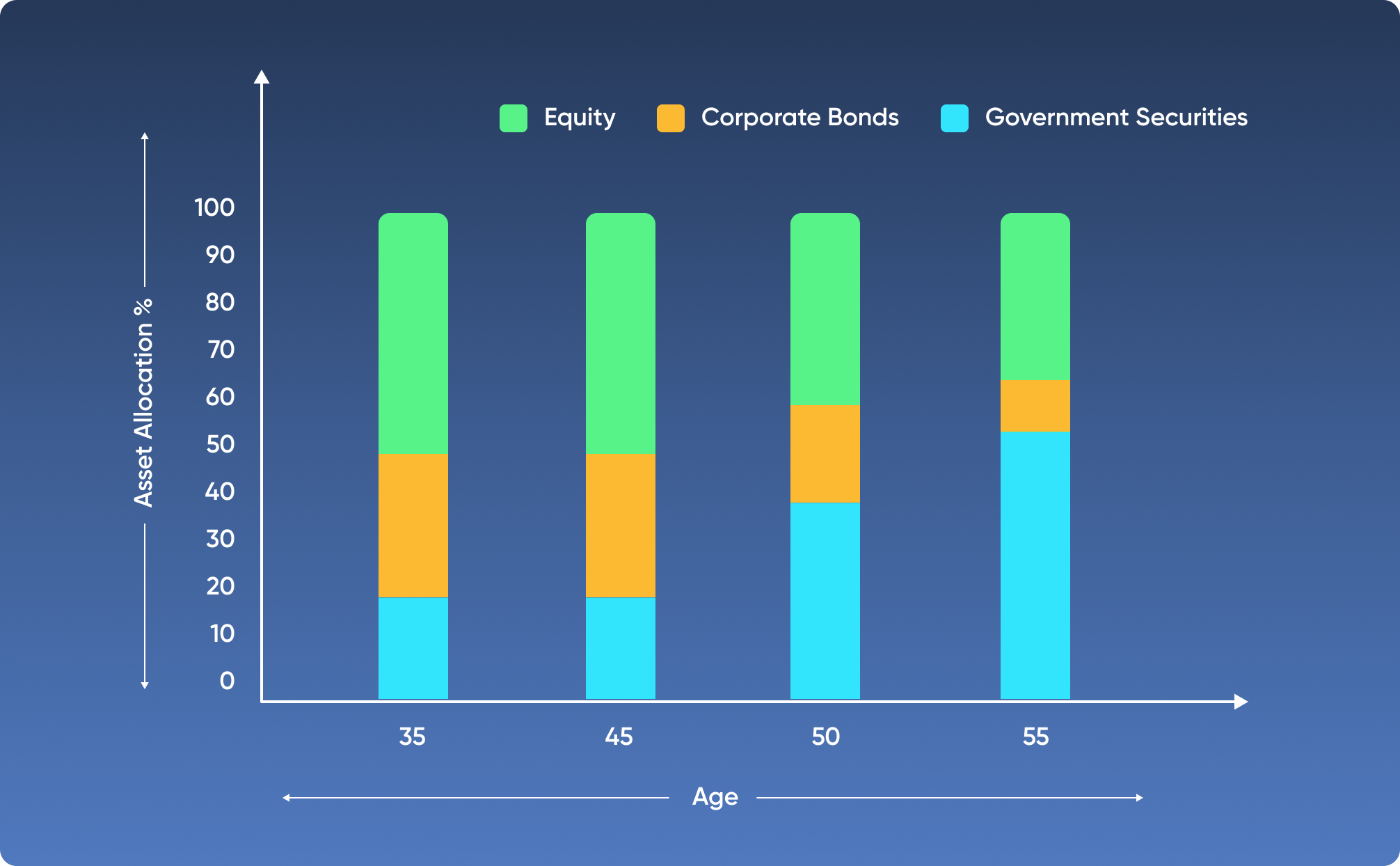
Auto Choice adjusts your portfolio automatically as you age, shifting from equity-heavy
growth in
your 30s to safer bonds and government securities by retirement, balancing growth with risk. There are four
types of Lifecycle Funds based on your risk appetite like LC75 (High), LC50 (Moderate), LC25 (Conservative)
&
Balanced Life Cycle Fund.
For example, in the Balanced Lifecycle Fund (LC100), the allocation evolves with age -
starting
with 50% in equity, which gradually reduces to 35% by age 55, ensuring a smooth transition from growth to
stability.
Active Choice - Manual Allocation:
Active Choice lets you control your allocations manually, maintaining higher equity or
adjusting bonds as you see fit. This approach is ideal for those who want flexibility and can handle
market
swings. Under the 2025 reforms, your investment options gain more flexibility and growth potential, with
Auto/Active Choice now compatible with multiple fund managers and Active Choice allowing up to 100%
equity
where suitable.
Auto/Active Choice now works with MSF, allowing diversified allocation across multiple PFMs
Active Choice can now leverage 100% equity for higher long-term growth, where suitable
Returns, Costs, and Tax Benefits
Returns (5-Year Annualised):
NPS is designed to deliver steady, market-linked growth over time. Equity-focused schemes
have
historically generated around. 14-16% per year, offering higher growth potential over the long term.
Corporate
bond schemes provide 6-7% annualised returns, balancing risk with moderate income, while government
securities
yield 5-6%, prioritising capital protection and stability. These returns reflect past performance and are
linked
to the performance of the underlying assets, highlighting the advantage of a diversified, professionally
managed
portfolio.
*Source NPS Trust. Returns as on 29th Oct'25.
Tax Benefits:
NPS remains one of the few retirement instruments offering triple tax benefits (EEE -
Exempt-Exempt-Exempt), meaning your contributions, the growth of your investments, and a portion of your
withdrawals are tax-efficient.
Contribution Type
Old Regime Deduction
New Regime Deduction
Personal Contribution
Up to ₹1.5 lakh under Section 80C
Not applicable
Additional NPS Contribution
₹50,000 under Section 80CCD(1B) (over 80C)
Not applicable
Employer Contribution (Corporate NPS)
Upto 10%(private)/14%(govt) of salary under Section 80CCD(2)
Up to 14% of salary (Basic + DA) under Section 80CCD(2) (This is the only NPS
benefit
under new regime)
Withdrawals & Retirement Options
NPS offers a structured yet flexible approach to accessing your retirement savings, balancing
long-term security with immediate financial needs. At retirement , you can now withdraw upto 80% of your
corpus of which 60% is tax-free, while the remaining portion is used to purchase an annuity. Even before
retirement, you can access a portion of your funds for important life events, with partial withdrawals of up
to 25% now proposed to increase upto 4 times, offering greater flexibility without compromising long-term
growth. Here are the key takeaways:
80% lumpsum withdrawls of which 60% of corpus can be withdrawn tax-free
Only 20% must be used to buy an annuity
Up to 25% of contributions can be withdrawn before retirement for specific needs - now proposed to
increase upto 4 permitted withdrawals
Comparing NPS with other retirement and investment options helps you make an informed
decision about
your
retirement planning
strategy.
Product
Return
Tax Benefit on Investment
Tax benefit on Maturity
Liquidity
Costs
NPS (Post-Reforms)
Upto 16%
Exempt (u/s 80 C, 80 CCD(1B), 80 CCD(2)
Partially taxable
Lock-in till age60 or 15 years (MSF)
0.01-0.30%
EPF
8.25%
Exempt (up to 1.5 L u/s 80C)
Tax-free
On job change/retirement
Nil
PPF
7.1%
Exempt (up to 1.5 L u/s 80C)
Tax-free
15-year lock-in
Nil
Mutual Funds
10-12%
Taxable (Select MFs exempt)
Taxable
Anytime
1-2%
FDs
6-7%
Taxable
Taxable
Limited
Nil
Is NPS Right for You?
If you value discipline, diversification, and compounding, NPS offers one of
the
most cost-effective retirement solutions in India - now upgraded with flexibility, MSF, and
higher growth potential through the 2025 reforms.
NPS has evolved from a rigid pension plan to a modern, modular,
investor-friendly
retirement solution. Start small, stay consistent, and let compounding and smart asset
allocation secure your financial independence.
NPS Variants
NPS VatsalyaA government-backed option designed for senior citizens or risk-averse investors. It focuses
on
lower-risk investments while still offering steady, market-linked growth over time
Atal Pension
Yojana (APY):Specifically for workers in the unorganised sector, APY guarantees a fixed monthly pension at
retirement. The government may co-contribute for eligible participants, making it an accessible
retirement option for lower-income individuals
Corporate NPS:Offered through employers, this variant allows contributions from both the employee and the
employer. Employee contributions are eligible under Section 80CCD(1B), while employer
contributions
get tax benefits under Section 80CCD(2), making it a structured and tax-efficient way for
salaried
professionals to build retirement savings
FAQs About Nation Pension System
Q. Can NRIs invest in NPS?
Yes, non-resident Indians can open an NPS account by completing basic KYC and
providing a PAN. The account remains portable even if you move across countries.
Q. Can I switch Pension Fund Managers (PFMs)?
Yes, you can change your PFM once a year to align with your risk appetite,
investment style, or fund performance.
Q. Can I have multiple NPS accounts?
Under the new Multiple Scheme Framework (MSF), you can hold multiple schemes
under the same Permanent Retirement Account Number (PRAN), enabling diversification across
different fund managers and asset allocations.
Q. What happens if I change jobs or cities?
Your NPS account is fully portable, so contributions continue seamlessly
regardless of job changes, relocations, or even moving abroad.
Q. Are there limits on contributions?
Tier I has minimum contributions to remain active, while Tier II is fully
flexible. The reforms do not change contribution limits but enhance flexibility in
withdrawals
and investment options.


















 08 Jun 2026