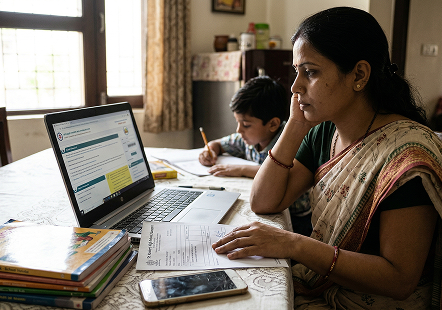
NPS Vatsalya PNB is a facility to open a National Pension System
account for a minor through Punjab National Bank by parents and legal guardians. The scheme
helps in creating a retirement investment from an early age with the help of regular
investments. Parents can choose their investment options, invest as per their financial capacity
and enjoy the tax benefits available under applicable income-tax provisions.
When planning for a child's future, parents generally focus on education and
healthcare. NPS Vatsalya is a contributory savings and long-term financial security scheme under
the National Pension System (NPS), regulated by
the Pension
Fund Regulatory and Development Authority (PFRDA) and designed exclusively for minors. The
account is opened
in the child's name and is operated by a parent or legal guardian until the child attains 18
years of
age.
Upto 12% market linked returns
Up to 100% equity allocation for higher growth potential
Tax benefits on Maturity
Up to 60% of corpus tax-free at exit
Flexible withdrawals
Withdraw at 18-21 yrs of age or switch to a regular NPS account
Investment flexibility
Flexible contributions. Your choice of equity, debt, or both
Pension Fund Regulatory and Development Authority (PFRDA)
Launch Date
18 September 2024
Eligible Subscriber
Minor below 18 years
Account Operator
Parent or Legal Guardian
Minimum Annual Contribution
₹250
Maximum Contribution
No upper limit
Account after 18 years
Can transition to a regular NPS account after KYC compliance
Investment Type
Market-linked retirement savings
What Is NPS Vatsalya PNB?
NPS Vatsalya PNB is a facility through which Punjab National Bank enables parents and legal
guardians to open an NPS Vatsalya account for a minor.
The account remains in the child's name from the beginning. However, the parent or legal
guardian manages it until the child reaches 18 years of age.
Money invested in the account is managed by Pension Fund Managers registered with PFRDA. NPS
is a market-linked investment, and hence returns are not assured. The final corpus will depend on the
long-term investment performance.
On attaining 18 years of age, the account can be continued as a normal NPS account after
completion of required Know Your Customer (KYC) formalities.
Starting to invest from a young age allows the principal to benefit from compounding over a
long period of time.
Who Can Open an NPS Vatsalya Account Through PNB?
The criteria for eligibility are simple. Parents/legal guardians may open the account when:
The child is underage (age under 18).
KYC must be completed and done by the parent/guardian.
Proof of identity/address is attached.
Acceptable documentation includes proof of the child's date of birth.
One NPS Vatsalya account can be opened for one child only. The parent or guardian acts as the
account operator until the child becomes an adult.
Contribution Rules
One reason many parents choose NPS Vatsalya is because of its flexible contribution
structure.
The important rules include:
Particular
Requirement
Minimum annual contribution
₹250
Maximum contribution
No limit
Contribution frequency
Flexible
Additional contributions
Allowed during the financial year
Parents can increase investment as their income grows and contribute more towards a secure
financial future for their children.
Investment Options Available
NPS Vatsalya follows the same broad investment framework as the National Pension System.
Such invested funds could be distributed across several different asset classes such as:
Fixed Income: This asset class is primarily concerned with fixed income securities.
They generally offer relatively stable returns and lower risk compared to equity investments, although
returns may vary based on market conditions.
Corporate Debt: It is an investment in quality corporate bonds. Commonly offers fairly
steady returns with moderate risk.
Government Securities: Since they carry Government guarantee, they are generally low
risk from an investment point of view. However, the returns can be lower in the long term invested in
equity.
Parents can choose Active Choice or Auto Choice. Contributions to NPS Vatsalya are invested
in market-linked assets based on the Pension Fund and investment option chosen by the guardian in accordance
with prevailing PFRDA guidelines. The investment can be made in equity, corporate debt, government
securities and other permitted asset classes.
How to Open an NPS Vatsalya Account Through PNB
Parents have access to open an NPS Vatsalya account in eligible Punjab National Bank branches
serving as Point of Presentation (PoP).
The process is simple.
Step 1: Visit a PNB Branch
Visit the closest PNB branch to get NPS service.
Step 2: Fill the Application Form
Fill the NPS Vatsalya Form with the information of the Child and Guardian.
Step 3: Submit KYC Documents
Provide necessary KYC documents such as ID proof, address proof and child's DOB proof.
Step 4: Do the First Contribution
Invest a minimum of ₹250, which must be made as the inaugural contribution during the
financial year.
Step 5: PRAN Generation
Once verified, a Permanent Retirement Account Number (PRAN) is issued for the child.
The parents are able to make further contributions to the account after activation using the
appropriate channels.
What Happens When the Child Turns 18?
NPS Vatsalya is designed to become a long-term retirement account. When the subscriber
reaches 18 years of age, the account does not close automatically.
Instead, the subscriber must complete fresh KYC formalities. After successful verification,
the account can be converted into a regular NPS account.
The subscriber has the following options between 18 and 21 years:
Continue under the NPS Vatsalya framework for up to three years.
Shift the accumulated corpus to a regular NPS account after completing KYC.
Exit from the scheme as per the applicable withdrawal rules.
If no option is exercised by the age of 21, the account is automatically shifted in terms of
the relevant PFRDA guidelines.
Withdrawal Rules Under NPS Vatsalya PNB
NPS Vatsalya encourages long-term retirement savings. But the plan does allow for withdrawals
under certain conditions.
Partial Withdrawal
Partial withdrawals are permissible after the account has been opened for three
years,
subject to conditions of PFRDA. A subscriber can withdraw up to 25% of their own contributions (not
including investment returns) under specified purposes:
Higher education of the subscriber
Treatment of specified illnesses
Disability of more than 75%
Skill building
Other purposes permissible by PFRDA
Note that partial withdrawal can be made up to three times during the tenure before
the
subscriber turns 18.
Exit After Attaining Majority
The rules of withdrawal are based on the accumulated corpus. The NPS Vatsalya account
can be
converted into a regular NPS Tier I account after the age of 18 years is attained by the subscriber
and
after the fresh KYC and other formalities are completed. Withdrawal and exit rules will apply as per
the
applicable NPS framework.
Tax Benefits of NPS Vatsalya PNB
NPS Vatsalya offers tax benefits to eligible parents or guardians under the old tax regime.
The following table summarises the current tax treatment.
Stage
Tax Benefit
Contribution
Deduction of up to ₹50,000 under Section 80CCD(1B), subject to applicable conditions
Partial Withdrawal
Partial withdrawal up to 25% of own contributions remains exempt under Section 10(12BA)
Exit
Lump sum withdrawal up to the prescribed exempt limit and the amount used to purchase an
annuity receive tax treatment as per the applicable provisions of the Income-tax law
Under the new tax regime, the additional deduction under Section 80CCD(1B) is generally not
available.
Tax rules may change from time to time. Investors should check the latest applicable
income-tax provisions before claiming deductions.
Benefits of Choosing NPS Vatsalya PNB
NPS Vatsalya helps parents to start their children's retirement planning early.
The major advantages are:
Long Investment Horizon: Early investments are given increased time to benefit from
compounding.
Flexible Contributions: No maximum contribution; parents may contribute as per their
ability.
Professional Fund Management: The Pension Fund Managers operating under the PFRDA
invest in different asset classes.
Easy Transition: After the child turns 18 and she/he finishes the KYC, the account can
be changed to a regular NPS account.
Easy Banking Assistance: PNB acts as a Point of Presence (PoP) and facilitates NPS
Vatsalya account opening, contributions and applicable servicing through its authorised NPS channels.
NPS Vatsalya PNB vs Regular NPS
NPS Vatsalya PNB and regular NPS are targeted at different age brackets and retirement
objectives. The following table summarises their main differences.
Feature
NPS Vatsalya PNB
Regular NPS
Eligible Subscriber
Minor below 18 years
Individuals between the eligible entry age
Account Operator
Parent or legal guardian
Subscriber
Purpose
Build retirement savings from childhood
Retirement planning for adults
Account Status at 18
Can convert into regular NPS
Not applicable
Regulator
PFRDA
PFRDA
Conclusion
NPS Vatsalya PNB enables parents to begin the process of retirement planning for their
children early on. The plan provides professional fund management, flexible contributions and a long-term
horizon for investment. Punjab National Bank is a registered Point of Presence, so parents can open and
operate the account through its authorised branches. Families need to know the investment risks, withdrawal
rules and tax provisions that apply to determine the best long-term financial decision before investing.
Q. Can
grandparents open an NPS Vatsalya account through PNB?
No. An NPS Vatsalya account cannot be opened and operated by anybody except the
parent/legally appointed guardian of a minor. Grandparents can open the account only if they are
the child's legal guardian.
Q. What
documents are required to open NPS Vatsalya through PNB?
The parent or legal guardian has to furnish the required proof of identity and
address, along with the minor's date-of-birth proof and other documents prescribed for
opening an NPS Vatsalya account. You may have to submit other documents to complete KYC and
account opening formalities.
Q. What is the
minimum contribution for NPS Vatsalya through PNB?
NPS Vatsalya has got a minimum contribution amount as per the scheme and you can
open the account accordingly. As per the published documents of PNB, NPS Vatsalya is a scheme of
the PFRDA and clearly mentions there is no upper limit while contributing to NPS Vatsalya. After
checking the latest PNB/PFRDA instructions and checking the minimum contribution allowable, the
account should be opened.
Q. Does PNB
offer NPS Vatsalya account opening services through its branches?
Yes. NPS Vatsalya account opening is offered by PNB through its authorised NPS
channels/branches. The bank is a Point of Presence for NPS related services. The scheme is
governed by PFRDA.
Q. How is PRAN
generated in a PNB-registered NPS Vatsalya account?
Once the application is completed, after taking the compulsory verification, a
Permanent Retirement Account Number (PRAN) is approved for the minor applicant. PRAN is a number
which is unique and allocated for your NPS account.
Q. Can an NPS
Vatsalya account be transferred from PNB to another Point of Presence (PoP)?
Yes, as per the guidelines issued by PFRDA subscribers are allowed to move their
NPS Vatsalya account from PNB to another authorised POP.
Q. Does PNB
manage the investments under NPS Vatsalya?
As a Point of Presence, PNB provides NPS services including account opening and
other applicable services. The contributions are invested as per the NPS investment framework
through the Pension Fund selected by the customer, as per PFRDA rules. Hence, PNB's role
as a banking/PoP channel should be differentiated from the Pension Fund's role in managing
the investments.
Q. Can I open
NPS Vatsalya for a minor through PNB?
Yes. NPS Vatsalya is for eligible Minor subscribers and PNB provides a channel
for the parents or legal guardians to get the account opened subject to applicable eligibility
and KYC norms. NPS Vatsalya is a scheme for Minor citizens below 18 years of age as identified
by published material of PNB itself.







 05 Oct 2026