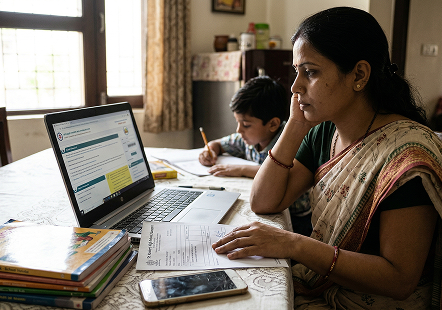
What is NPS Vatsalya Kotak Mahindra Bank?
NPS Vatsalya Kotak Mahindra Bank refers to opening an NPS Vatsalya account through Kotak
Mahindra Bank, an authorised Point of Presence under the National Pension System (NPS).
It is important to understand that Kotak Mahindra Bank does not operate a separate pension
scheme. The pension product is NPS Vatsalya, which is regulated by PFRDA. Kotak Mahindra Bank only provides
the platform to help parents and guardians register, complete KYC, make contributions and manage the
account.
The scheme allows a parent or legal guardian to open a pension account for a child below 18
years of age. The investments remain in the child's name from the beginning. However, the parent or guardian
operates the account until the child reaches adulthood.
The subscriber must complete fresh KYC formalities on attaining the age of 18 years. After
completing KYC, the subscriber can choose to continue in NPS Vatsalya until the age of 21, shift the entire
accumulated corpus to NPS under the All Citizen Model or exit from NPS Vatsalya subject to the applicable
withdrawal rules. If the subscriber does not exercise an option by age 21, the account automatically shifts
to a higher-equity scheme under the Multiple Schemes Framework (MSF) and is thereafter governed by the
applicable NPS exit and withdrawal regulations.
This enables the child to begin retirement planning early and provides investments with
decades of growth.
Key Features of NPS Vatsalya Kotak Mahindra Bank
NPS Vatsalya provides facilities to help children with long-term retirement planning.
- Early Saving for Retirement: The longer the pension corpus is invested, the greater will be the
potential benefit from long-term compounding.
- Flexible Contributions: Available for parents or legal guardians to make according to convenience with
the specified minimum contributing amount per year.
- Market-Linked Growth: Equity, corporate and government securities investments. Returns are
market-linked.
- Professional Fund Management: Investments are made through pension fund managers who are registered with
the PFRDA.
- Options After Age 18: Post KYC, after the 18th year, the subscriber may either continue in NPS Vatsalya
till 21 years of age, transfer the corpus to NPS or exit subject to the applicable exit provisions.
Who Can Open an NPS Vatsalya Kotak Mahindra Bank Account?
Eligibility for the scheme is simple. It can be opened by a parent or legal guardian when:
- The minor is below 18 years of age.
- The minor is an eligible Indian citizen, including an NRI or OCI minor, subject to the applicable PFRDA
and KYC requirements.
- The account is opened in the minor's name and operated by a parent or legal guardian.
- The required KYC and supporting documents are submitted by the guardian.
For NRI or OCI guardians, additional requirements may apply, including the applicable NRI/OCI
form and an NRE or NRO bank account.
Contribution Rules
NPS Vatsalya offers flexibility in contributions.
| Contribution Requirement |
Details |
| Minimum Initial Contribution |
₹250 |
| Minimum Annual Contribution |
₹250 |
| Maximum Contribution |
No limit |
| Contribution Frequency |
Flexible throughout the financial year |
It allows parents to increase investment as their income grows and contribute more towards a
secure financial future for their children.
Investment Options Available
NPS Vatsalya provides investment options and allows the guardian to choose asset allocation
and Pension Fund Manager. The guardian will be given the option to choose a Pension Fund and Active Choice /
Auto Choice available, as per the provisions of the PFRDA rules.
-
Active Choice
In Active Choice, the subscriber will have the option to allocate funds between the
allowed
asset classes in line with the cap laid down:
- Equity (E): Up to 75%
- Corporate Bonds (C): Up to 100%
- Government Securities (G): Up to 100%
- Alternative Investment Funds (A): Up to 5%
All selected asset classes must add up to 100%.
-
Auto Choice
There is a linkage between the investment allocation and age of the subscriber under
Auto
Choice in accordance with the Lifecycle Investment Strategy.
- Life Cycle 25 - Low (LC25)
- Life Cycle 50 - Moderate (LC50)
- Life Cycle 75 - High (LC75)
The allocation will be adjusted automatically on the subscriber's advancement in age.
| Life Cycle Fund |
Maximum Equity Allocation |
Suitable For |
| Aggressive (LC-75) |
Up to 75% |
Higher risk tolerance |
| Moderate (LC-50) |
Up to 50% |
Balanced investors |
| Conservative (LC-25) |
Up to 25% |
Lower risk preference |
Documents Required to Open an NPS Vatsalya Kotak Mahindra Bank Account
Depending on the applicant and mode of application, the specific documents may vary. The
following documentation will usually be required:
- KYC documents of the parent/legal guardian and proof of identity.
- Address proof of the guardian
- Document, including a passport or birth certificate, that establishes the minor's date of birth (as
required by applicable NPS KYC requirements).
- Photograph and other details required for account registration.
- Other documents required for NRI/OCI guardians (if any), e.g. NRI/OCI form, NRE/NRO bank account details
etc.
Kotak Mahindra Bank reserves the right to ask for further documents or KYC information as per
prevailing requirements to open an account and/or regulatory requirements.
How to Open an NPS Vatsalya Kotak Mahindra Bank Account
Parents/legal guardians will be able to open an NPS Vatsalya account at any authorised Point
of Presence or at any relevant NPS online Point of Presence. In the case of Kotak Mahindra Bank, the
onboarding process should be the same as the existing facility of NPS Vatsalya and KYC norms provided by the
bank.
- Visit Kotak Mahindra Bank or an Applicable NPS Channel
Visit any Kotak Mahindra Bank branch/service point where you can register for NPS
Vatsalya or
visit the online NPS facility provided for the scheme.
- Fill the NPS Vatsalya Application
Provide the required details of the minor and parent/legal guardian.
- Complete KYC
Turn in the appropriate ID, address and date of birth paperwork as necessary.
- Make a selection of the Applicable NPS Choices
Based on the NPS Vatsalya options available to the guardian, he can make all the required
choices like selecting Pension Fund Manager and investment allocation.
- Make the Initial Contribution
Start your contributions with a minimum of ₹250.
- Get the PRAN and Account Details
On successful registration and verification, the minor's PRAN and details of the account
are
shared based on the applicable NPS process.
Withdrawal Rules Under NPS Vatsalya
NPS Vatsalya is a long investment period product, and there is no option of part withdrawals
unless the conditions specified by PFRDA are fulfilled.
-
Partial Withdrawal
Partial withdrawals can be made after completing 3 years from the date of opening the
account. The maximum withdrawal is 25% of the minor subscriber's own contributions, excluding
returns.
Allows partial withdrawals for:
- Education of the minors.
- Treatment of specified sicknesses of the minor subscriber
- Disability of more than 75% of the minor subscriber
The rate of withdrawal is limited as well:
- Until the subscriber reaches 18 years of age: A maximum of 2 partial withdrawals.
- Between 18-21: 2 more partial withdrawals (after completion of prescribed KYC)
-
Options After the Child Turns 18
Once the subscriber becomes 18 years old, the process of KYC is to be repeated, and
then the
subscriber may opt for any of the below from the age of 18 to 21:
- Stay in NPS Vatsalya till age 21.
- Transfer all the corpus into NPS to include the All Citizen Model or a suitable model.
-
Exit from NPS Vatsalya
If the total of the corpus reaches less than ₹8 lakh, the entire amount can be
withdrawn. In
case an individual contributes ₹8 lakh or above, he may withdraw up to 80% of the corpus in a lump
sum, and
the balance 20% of the corpus must be invested in purchasing an annuity.
After age 21, if any option is not taken up, the account goes into the next
higher-equity
scheme under the Multiple Schemes Framework and will then be further subject to the NPS exit and
withdrawal
regulations applicable to the account.
Tax Benefits of NPS Vatsalya Kotak Mahindra Bank
Contributions to NPS Vatsalya may provide tax benefits subject to the applicable provisions
and conditions under the Income-tax law.
If a parent/legal guardian contributes to the NPS Vatsalya minor account, they can claim a
tax deduction of up to ₹50,000 under Section 80CCD(1B) under the old tax regime if applicable.
The deduction is not available under the new tax regime.
Partial withdrawal up to 25% of own contributions is exempt under Section 10(12BA) when
received by the assessee who is parent or guardian of the minor.
NPS Vatsalya Kotak Mahindra Bank vs Regular NPS
NPS Vatsalya Kotak Mahindra Bank and regular NPS serve different age groups and retirement
goals. The table below highlights their key differences.
| Feature |
NPS Vatsalya Kotak Mahindra Bank |
Regular NPS |
| Eligible Subscriber |
Minor |
Adults |
| Account Operated By |
Parent or legal guardian |
Subscriber |
| Purpose |
Early retirement planning |
Retirement planning |
| Minimum Contribution |
₹250 annually |
As prescribed under NPS rules |
| Options at age 18 |
Continue in NPS Vatsalya up to age 21, shift the corpus to NPS after completing KYC, or exit
subject to applicable rules |
Governed by the applicable NPS exit and withdrawal rules |
| Regulator |
PFRDA |
PFRDA |
Conclusion
NPS Vatsalya Kotak Mahindra Bank helps parents and legal guardians in starting retirement
planning for their child at an early age. Taking into account that Kotak Mahindra Bank is the Authorised
Point of Presence, they provide support to their consumers in the entire process of account opening and
servicing.
The scheme combines flexibility in contributions, experienced fund management and long term
investment horizons. Early investments have long term compounding benefits. Parents should review the latest
PFRDA guidelines, understand that returns are market-linked and subject to market risks, and check the
applicable tax provisions under the Income-tax Act before opening an account.




 05 Oct 2026