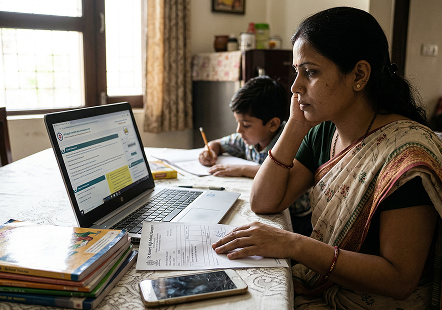
The SSY full form is Sukanya Samriddhi Yojana Scheme. The scheme is part of the Beti Bachao, Beti Padhao campaign. The scheme was introduced in January 2015 by the government of India.
Historically, a girl child often lacked the right opportunities due to financial strain. Parents often struggled to pay for their education. But through the Sukanya Samriddhi Yojana, parents can now make small, regular contributions, ensuring their daughter has a financially secure future.
As a government-backed scheme, the invested money is secure, and the income is also tax-exempt, making it the right investment tool to ensure your daughter has her future dreams safe, despite any changes in circumstances.
This article explains the Sukanya Samriddhi Yojana interest rate, main benefits, eligibility and other important information.
Key Features of Sukanya Samriddhi Yojana
Sukanya Samriddhi Yojana Scheme is a small savings scheme introduced by the government, especially for girl children. The scheme differs from most investment schemes where anyone can be the beneficiary; it helps popularise the financial planning for daughters under the Beti Bachao, Beti Padhao initiative.
The Sukanya Samriddhi Yojana interest rate is currently set at 8.2%, which can be revised by the government from time to time. The interest rate is higher than that of a regular FD, and it is not a market-linked scheme, such as a mutual fund, therefore, offering a more predictable return.
Given below are some of the standout features of the Sukanya Samriddhi Account Scheme that have made it a preferred savings option for families with daughters:
- It has a higher interest rate than traditional savings options.
- The account is managed by parents/guardians until the daughter attains legal age, 18 years.
- Parents can make multiple deposits in a financial year, as long as the total amount doesn't exceed ₹1,50,000.
- A partial withdrawal facility is available with the SSY.
- The account can be easily transferred between a post office and an authorised bank, and vice versa.
- Only one account can be opened in the name of one girl child.
- The SSY is a long-term investment option, as the account reaches maturity only 21 years after account opening.
Eligibility Criteria for Sukanya Samriddhi Yojana Scheme
The following criteria must be met for investing in the SSY Scheme:
- The Sukanya Samriddhi Yojana age limit is set at 10 years; the daughter must be under this age to qualify.
- This investment scheme is only available to Indian girl children.
- A maximum of two accounts can be opened per family, but in the case of twins or triplets, the rule doesn't apply.
Sukanya Samriddhi Yojana Account Scheme: Deposit Limit and Default Rules
One of the biggest benefits of the Sukanya Samriddhi Yojana is that it requires only a very nominal amount of ₹250. This is not always the case with other available savings and investment tools. The maximum permissible investment limit is ₹1,50,000 in a financial year.
While the account attains maturity in 21 years from the date of the first deposit, investments are made for the first 15 years. For the remaining tenure, the corpus earns the applicable interest rate.
If a parent fails to make a minimum deposit of ₹250 in a financial year, the Sukanya Samriddhi Yojana account defaults. To reactivate the account, the minimum deposit amount must be paid for each year that you've defaulted. In addition, a penalty of ₹50 is also levied for each default year.
For example, if you default for one year, you have to pay ₹300 (₹250 + ₹50) to reactivate the SSY account.
How to Apply for the Sukanya Samriddhi Yojana Scheme?
Investing in the SSY scheme can be done by visiting your nearest post office or any of the authorised bank branches. To apply, you will have to fill out the required form (SSA-1), provide the necessary documents and make a first payment of ₹250. You can pay the amount through cash, demand draft, or cheque.
Documents Required for Sukanya Samriddhi Yojana Scheme
You must furnish the following documents when applying for the SSY Scheme:
- A copy of your daughter's original birth certificate must be provided to verify the age (you must also carry the original).
- Passport-sized photographs of the child and the parent/guardian.
- Government-issued identity proof of the parent/guardian (PAN card, Aadhar card, Passport, Voter ID, and driving license).
- Address proof of guardian or parent.
- Medical certificate, in case of multiple births like twins or triplets.
You must carry both the original and a photocopy of the above-mentioned documents.
How to Withdraw Money from the Sukanya Samriddhi Yojana
Sukanya Samriddhi Yojana matures in 21 years from the opening of the account. Partial withdrawal can be made only in the following circumstances:
- Partial withdrawal is permitted for higher education once the girl child passes class 10 or attains 18 years of age, whichever is earlier, subject to applicable SSY rules.
- A maximum of 50% of the total available amount can be withdrawn.
- Funds can be used for higher education, while account closure is permitted for marriage under SSY rules.
A formal application must be made to make a partial withdrawal. For funding further education, an admission slip or fee slip from the educational institution must be provided. For marriage-related purposes, an affidavit and age proof must be provided. In case of marriage, the account can also be closed; however, the authorities must be informed a month before the wedding or within three months after the marriage.
Sukanya Samriddhi Yojana Tax Benefits
Investing in the Sukanya Samriddhi Yojana Scheme is not just beneficial for safeguarding your daughter's future but can also help with tax planning. SSY continues to enjoy EEE (Exempt-Exempt-Exempt) tax status. However, Section 80C deductions on deposits are beneficial only for taxpayers opting for the old tax regime.
However, the yearly interest credited to the SSY account is completely tax-free. Similarly, the entire amount (principal and interest) obtained at maturity or during partial withdrawal is completely tax-free.
The competitive rates and tax exemption upon maturity are some of the biggest Sukanya Samriddhi Yojana benefits, making it popular among parents looking to provide financial security to their daughters.
Sukanya Samriddhi Scheme Calculator
The Sukanya Samriddhi Scheme calculator can help you calculate the maturity value according to the yearly deposits and the prevailing interest rate. The government is paying 8.2% interest per year compounded annually.
In other words, Mr Sen contributes ₹50,000 per annum. The interest rate is taken at the current valuations. He goes on to make the same amount of deposit for the next 15 years. If he had invested ₹2,50,000 for 5 years, the estimated amount then would be ₹3,17,000. His total investment in the 15th year would be ₹7,50,000, and the total corpus balance accumulated till the 15th year would be ₹15.13 lakhs.
The interest earned on the corpus will continue to be compounded, and after 21 years, the Sukanya Samridhi Yojana time period maturity amount will be around ₹23-24 lakhs, depending on the prevailing interest rates.
Conclusion
Sukanya Samriddhi Yojana has gained popularity since its inception, as it acts as a long-term and safe investment tool offering stable returns. Inflation and a bad economy can often impact plans, but through government-backed investment schemes, it is possible to mitigate future risks.
After 21 years, your daughter receives a lump sum amount that allows her to follow her dream, whether it is to get an advanced degree, get married, or start a new business venture.





 01 Jul 2026