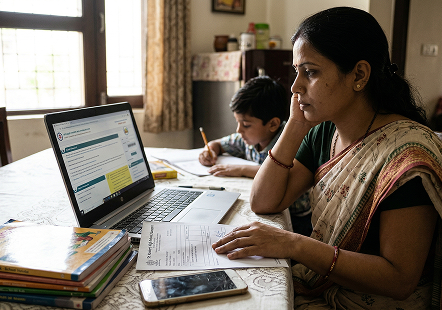
Joint Family System Breakdown in India: Reasons and Impact
The old joint family system has gradually declined due to rapid
urbanisation, migration, changing lifestyles, and growing preference for nuclear families in
India. Smaller homes, individualism, and shifting family dynamics have encouraged people to move
away from shared living arrangements. With fewer shared responsibilities, financial and
emotional pressure often falls on one earning member. Changing relationships, independent
decision-making, and rising living costs have further contributed to the shift from joint
households to nuclear family structures.
Peaceful Post-Retirement Life
Build a secure corpus for a worry-free retirement.
Tax-Free Regular Income
Enjoy regular income with applicable tax benefits.
There was a time in India when ageing parents rarely worried about growing old alone. Someone was
always around. A brother upstairs. Grandparents living in the next room. Cousins filling the house with noise.
The joint family system was not just a cultural tradition; it was India's original social security network.
Apartments are smaller. Families are smaller, too. Parents now live in Jaipur while children work
in Gurugram, Bengaluru, Dubai, or Toronto. And somewhere in this transition from joint households to nuclear
family setups, the meaning of family support itself has quietly changed.
The shift has brought greater freedom, privacy, and independence. But it has also created new
pressures around elderly care in India, childcare costs, emotional isolation, and the financial burden of living
separately. To understand modern India, you must first understand how the Indian family itself is evolving.
What is the Joint Family System? And What's Replacing It?
xBefore examining the causes, let us first understand the family structure that has become
obsolete. The joint family system refers to an extended family comprising several generations of members who
share living space under one roof, a common kitchen, and common property. It was a mini society with
built-in childcare, financial, and emotional support systems.
The current trend is the rapid growth of nuclear families in India. This refers to a small
household typically consisting of parents and their children, living separately from the extended family.
Recent surveys, such as the National Family Health Survey (NFHS) and household studies, indicate that
nuclear families have become increasingly common in urban India; the exact share varies by city and state.
Top 5 Reasons for the Breakdown of the Joint Family System
What has brought about such a dramatic change in a system that supported many Indian
households for generations? There is not just one reason for it. It has become a "perfect storm" of economic
and social factors.
Urbanisation Effect and Migration of Employment
The first factor is the pursuit of better opportunities. By 2026, India's economy
will focus more on industrial areas and technology-driven cities. As such, a young person growing up
in a village in Bihar or even a town in Kerala may have no choice but to move to a metro city to
start a career.
However, urban living can be costly, and most often people end up having smaller
houses. Thus, bringing the whole joint family structure into an apartment is impossible due to the
effects of urbanisation. As a result, many young couples end up living separately from their
extended family, therefore causing the geographical breakdown of family structures in India.
Changing Gender Norms and Increased Female Independence
Women were stereotyped into taking care of all household chores and duties while
running after members of joint families. However, by 2026, the female population will be more active
in the job market than before. When both spouses are busy with their respective work, household
conflicts are quite common. As such, the modern family in India is usually a nuclear family, in
which couples often seek greater privacy and a more independent division of responsibilities.
The Need for Privacy and Individualism
In the past, "we" were more prominent than "me". Today, there has been a very
significant social transformation in India towards individualism. The younger generation wants the
freedom to choose anything, right from the food they eat for dinner to how they furnish their house
or bring up their children, without getting approval from any patriarchal or matriarchal family
members. This need for space and "autonomy of lifestyle" is the main cause of the division.
Role of Information Technology
Information technology has shrunk the world. Social networking sites, exposure to
global content and lifestyles through media, and migration have also influenced preferences for
smaller independent households. This shift has transformed the ideal concept of success. At times,
the joint family structure seems like a hindrance to modern life.
Economic Independence and Fragmentation of Wealth
In the good old days, the family business or farm held everyone together since the
resources were collectively owned. Nowadays, individuals earn their salaries as professionals. When
you earn your salary, you will surely feel entitled to spend the money as you wish. Moreover, the
inheritance of family property among brothers marks the final stage in the disintegration of the
joint family system.
The Effect: The Good, The Bad and The Pricey One
There is always an underlying cost to any significant social evolution in India. Let us
examine what effects this development has had on our lives.
The Benefits: Freedom and Versatility
For Indian nuclear families, there is greater freedom and flexibility. Everything
moves faster without the drama caused by handling various personalities in one household. Nuclear
families are very flexible, as they can relocate to other countries when more lucrative job offers
come their way.
The Negative: "The Care Gap"
This is the hardest consequence. Under joint family systems, childcare was free and
plentiful. In single-family living, working adults find it difficult to afford costly creches and
leave their children in the hands of strangers.
But the worst situation in terms of care is elderly care in India. Now that the
children have gone, the parents are alone in their hometowns. Social isolation and loneliness among
some elderly people have become growing concerns, especially when children live elsewhere.
Financial Consequences: Cost of Living Independently
Living alone becomes expensive. The conversion of a joint family system into three nuclear
family units significantly increases the financial burden.
Housing: With the dissolution of the joint family system, one spacious house is necessarily replaced by
three smaller apartments.
Childcare: "Grandma/Grandpa" services get supplanted by paid child-minding services.
Redundancy: Instead of a washer and a car, now there will be three of each.
Expense Category
Joint Family Advantage
Nuclear Family Challenge
Rent/EMI
Shared across earners
Borne by a single couple
Groceries
Bulk buying (Cheaper)
Small quantities (Costlier)
Elderly Care
At-home, family-led
Paid caregivers or assisted living
Childcare
Natural, multi-gen support
Paid crèches or day-boarding
Emergence of the "Sandwich Generation"
This breakdown process has produced a completely new category of people called the "Sandwich
Generation". These are the middle-aged Indians who find themselves sandwiched between the demands of their
kids and their older parents. As there is no longer any joint family network to shoulder some of the burden,
the stress these individuals face is overwhelming, both physically, emotionally, and economically. That is
why organised elder care services, assisted living, and home-care businesses are expanding in India.
The fall of the joint family does not indicate anything "good" or "bad"; it is just another
phase that India has reached. As we modernise and move toward a career-oriented nuclear family in India,
there are some things that we have to face. We cannot have our lives in 2026 with the support of 1950s
families.
The secret is adjusting over time. While we will leave home for our careers, we have to plan
for elderly care in Indian cities and try to develop other community-based Indian families. Our family is
not vanishing; it is transforming itself in accordance with time and circumstances. Regardless of whether we
belong to a family of twenty or two, it is crucial to maintain unity and love, even from afar.
FAQs
Q. Is The Joint Family System Extinct In India?
No, the joint family system still exists in many parts of India. It remains
common in rural areas and among business families. In urban cities, many families now follow
hybrid arrangements in which the relatives live separately but continue to support one another
closely.
Q. What Difference Does A Nuclear Family Make To Children?
Children in nuclear families often receive more personal attention and develop
independence at an early age. However, they may have limited interaction with extended family
members. Joint families can provide stronger cultural exposure, emotional support, and shared
learning experiences for children.
Q. Is Urbanisation Entirely Negative For Indian Families?
No, urbanisation has both positive and negative effects on Indian families. It
may increase physical distance between relatives, but it also creates better education,
employment, and lifestyle opportunities. Urbanisation has also encouraged financial independence
and reduced certain traditional social restrictions.
Q. How Is Elder Care Managed In Nuclear Family Systems?
Many nuclear families in India now depend on professional elder care services for
senior citizens. These services include home nursing, assisted living, senior daycare centres,
and healthcare support. Financial planning and health insurance have also become important parts
of long-term elder care management.
Q. Why Are Younger Generations Moving Away From Joint Families?
Career opportunities, higher education, migration to cities, and financial
independence are major reasons behind the rise of nuclear families. Younger generations also
prefer greater privacy, flexible lifestyles, and independent decision-making, which are often
easier to maintain in smaller family setups.
Q. What Are The Biggest Advantages Of The Joint Family System?
Joint families provide emotional support, shared financial responsibilities,
childcare assistance, and companionship for elderly family members. They also help preserve
cultural values and traditions. Shared living arrangements can reduce household expenses and
strengthen family support systems during difficult situations.
Q. Can Joint And Nuclear Family Systems Coexist In Modern India?
Yes, many Indian families now follow flexible family structures that combine
elements of both systems. Relatives may live separately while remaining emotionally and
financially connected. This arrangement allows families to maintain independence while
continuing family support and cultural relationships.






 22 Oct 2026