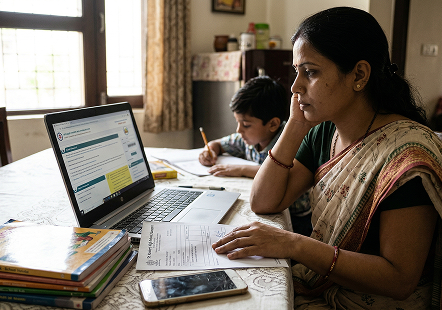
As a senior citizen, you need your money to work hard for you. While you may be familiar with
investment habits like EPF/PPF or traditional insurance, your investment strategy must now shift to reflect your
new priorities. To help you navigate this new landscape, we will focus on three top government-backed savings
options for 2026: the Public Provident Fund (PPF), the Senior Citizen Savings Scheme (SCSS), and the Sukanya
Samriddhi Yojana (SSY). Which of these is truly the best choice for you as a senior citizen? Let's simplify the
details and find out.
Senior Citizen Savings Scheme (SCSS): The best place to begin for your retirement
plans
If you are 60 or older, SCSS is the first place you should turn to for your retirement plans.
It is designed
by the government specifically so you can receive risk-free returns.
-
How SCSS works for you
As of early 2026, SCSS is offering an attractive 8.2% per annum, payable quarterly.
Also, unlike most
other
schemes, SCSS allows you to receive interest every quarter.
Let's take an example: The maximum you can invest is ₹30 lakh. So, if you invest the
maximum amount
of
₹30 lakh at an interest rate of 8.2%, you can earn an interest of ₹2,46,000 annually. This is
equivalent to
approximately ₹61,500 credited to your account every quarter. This is almost like having your own
pension
scheme for daily expenses.
If you are considering an annuity provided by any private life insurance company or
your EPF/PPF
account, you
would find SCSS is not only more flexible but also provides you with an even higher rate of return
on the
first ₹30 lakh of your retirement corpus.
-
The Tax Angle
Investing money in an SCSS account helps you claim deductions up to ₹1.5 lakh under
Section 80C.
However, the
interest earned on the investment is taxed according to your income tax slab. The good news is that
senior
citizens can claim deductions up to ₹50,000 on interest income earned by investing in SCSS accounts
under
Section 80TTB.
Public Provident Fund (PPF): The Tax-Free Wealth Builder
While you might be familiar with the Employee Provident Fund (EPF) as a mandatory deduction
during your
working years, the Public Provident Fund (PPF) is a distinct, voluntary long-term savings option. Even after
retirement, the PPF remains a powerful tool for wealth preservation. Let's evaluate if this option
still fits your current financial strategy.
-
How it works for you
The PPF is available to all Indian citizens regardless of age. It currently offers an
attractive
interest
rate of 7.1% annually. However, there is a condition: a 15-year lock-in period is mandatory for
investing in
PPF accounts. If you open a new PPF account at age 60, the account will mature only by the time you
are 75
years old. Hence, this option is not recommended for those who need cash for daily expenses.
If you already have a mature EPF/PPF account from your working years, you're largely
in a privileged
position. After the initial 15-year maturity period, your PPF accounts can be extended in blocks of
5 years,
either with fresh contributions or without additional deposits. Note that it is wise to start by
doing an
EPF balance check to understand how much retirement corpus you already have.
-
Tax angle
One aspect that you should be aware of is that this is where the PPF really scores.
The PPF qualifies
for the
super-exclusive Exempt Exempt Exempt (EEE) category. This means that your annual deposit (up to ₹1.5
lakh)
qualifies for a tax deduction, the interest you earn over the years remains completely tax-free, and
the
money you receive when you mature it remains completely tax-free too.
Sukanya Samriddhi Yojana (SSY): A Parent's Gift
What if you already have your retirement plans in place and want to use your savings for your
daughter's education and marriage? Enter the Sukanya Samriddhi Yojana (SSY), a thoughtful scheme
designed specifically for funding your girl child's education and marriage.
-
How it works for you
SSY currently offers an impressive 8.2% annual return, matching SCSS returns. The
account matures after 21
years from the date of opening. Premature closure is allowed if the girl child marries after the age
of
18.
One thing to remember with the SSY scheme
The latest government clarification regarding the role of the grandparents:
Only parents or legal guardians can open the Sukanya Samriddhi account. If the girl
child's
grandparents have to open the account, they must be the legal guardians.
What can the grandparents do?
If the grandparents want to invest for the girl child, then the grandparents can give
the money to the
son/daughter, who can then invest the money in the SSY account for the girl child.
-
The Tax Angle
Just as is the case with the PPF, the Sukanya Samriddhi Yojana too has the coveted
EEE tax benefit. Your
money grows absolutely tax-free, and hence, once your granddaughter is ready to take up further
studies, you
will have a substantial amount of untaxed money waiting to be used.
Direct Comparison: Which option is best for you?
What you want to achieve through this investment is what will decide which of these is the
"best."
- SCSS: This is ideal if you prioritize a high-yield, regular income during retirement.
Since interest is paid out quarterly, it is particularly effective for managing recurring daily living
expenses.
- PPF: This remains a top choice if you do not require immediate liquidity, fall into a
high tax bracket, and seek a completely tax-free growth environment for your capital.
- SSY: This is a specialized gift for your daughter or granddaughter, designed to build a
significant, tax-exempt corpus for her higher education and marriage milestones.
Conclusion
Retirement is not about finding a magical financial solution. It is about building an overall
plan that
brings you genuine peace of mind. For most senior citizens, the safest bet is the Senior Citizen Savings
Scheme, given its high 8.2 percent returns and quarterly returns. Once you have exhausted the limit of Rs.
30 lakhs, it is always an option to continue your old Public Provident Fund account for tax-free returns, or
open an SSY to treat your granddaughter.



 05 Oct 2026